Altar & Church Covers
23 items
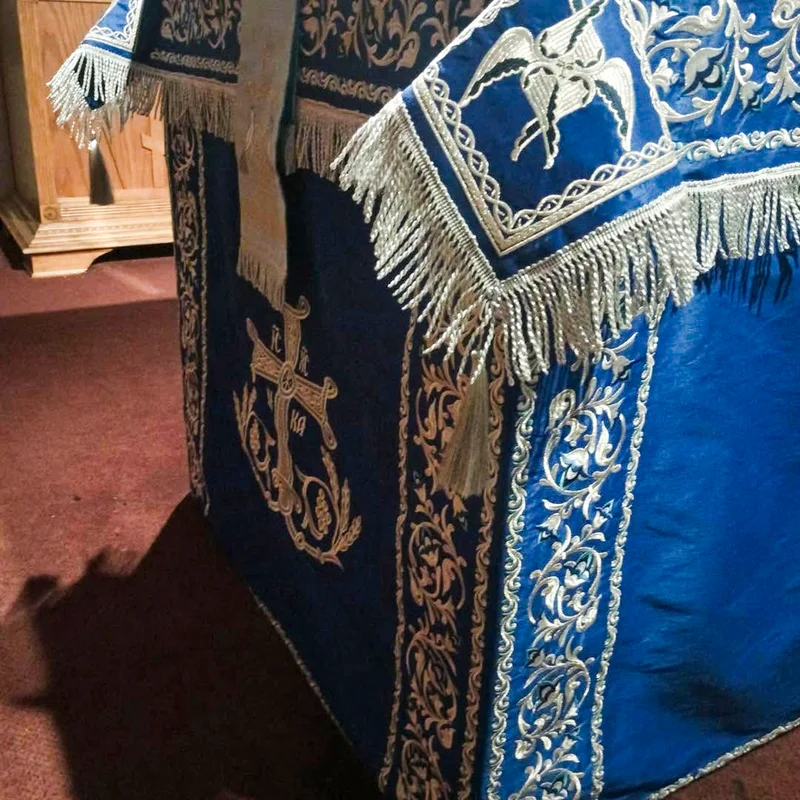


The altar cover — the cloth draped over the Holy Table during the Liturgy — is the most visible textile in the church after the icons. Ours are sewn from heavy brocade in your chosen liturgical colour, with hand-embroidered crosses, icons, or scripture inscriptions, and sized to fit Holy Tables of any dimension.
We make altar covers for parishes, monasteries, and home chapels around the world. Whether you're consecrating a new Holy Table or replacing a worn set, we'll match the colour and embroidery style of your existing vestments and analogion covers so the whole sanctuary reads as one composition.
The role of the altar cover in Orthodox worship
The Holy Table (in Greek tradition, the Agia Trapeza) is consecrated as the symbolic tomb of Christ. The altar cover is its outermost garment — the visible layer the faithful see, and the surface on which the Gospel, the antimins, and the holy vessels rest during the service. Beneath it are the linen cloth (the katasarkion, "next to the flesh") and the antimins, both of which remain on the altar permanently after consecration.
Because the altar cover is what the eye returns to throughout the Liturgy, its colour and design carry the liturgical season more strongly than any other textile. A gold cover for Pentecost, deep red for Holy Week, white for Pascha — these are felt as much as seen.
Liturgical colours of altar covers
Most parishes order at least two full altar covers (gold for ordinary time and one penitential colour). Larger parishes maintain six or seven, one for each liturgical colour:
- Gold — the default for most Sundays of the year.
- White — Pascha and Bright Week, Theophany, the Nativity, the Transfiguration.
- Red / burgundy — feasts of martyrs; Holy Week (Slavic tradition).
- Blue — feasts of the Theotokos.
- Green — Pentecost, Palm Sunday, feasts of monastic saints and ascetics.
- Purple / dark red — Great Lent, feasts of the Cross.
- Black — Great Lent weekdays (Slavic tradition), funerals.
How we make altar covers
An altar cover is a substantial piece of textile — typically 1.2–1.5 metres on each side, plus a deep drop on each face of the altar (35–50 cm depending on table height). We use the same brocade weights as our priest vestments, reinforced at the corners and along the top edge where the cover is handled most.
The central embroidery — usually a cross, an icon of the Resurrection, or a symbolic motif (the Lamb, the Burning Bush, the Holy Spirit as a dove) — is worked separately on a stretched frame, then mounted onto the brocade. This approach lets us achieve much finer goldwork than embroidering directly onto a heavy fabric, and it means the embroidery can be salvaged and re-mounted onto new fabric if the cover ever wears out.
Measuring your Holy Table
When you order, please send us:
- The dimensions of the top of the Holy Table (length × width).
- The height from the floor to the top.
- How deep you want the cover to drop on each side (35 cm is typical; longer if the altar is in a small sanctuary and the floor is visible).
- Any photographs of the altar so we can see how the cover will read in context.
Coordinating with other altar textiles
Many parishes order altar covers together with matching analogion (lectern) covers, chalice covers, and a banner of the patronal feast. Ordering a coordinating set ensures the brocade matches exactly and saves significantly compared to ordering each piece individually. Browse our analogion covers and chalice covers.
Frequently asked about altar covers
What size should an Orthodox altar cover be?
The cover should be sized to the top of the Holy Table plus an overhang on each face. For a standard 1×1 metre altar, we recommend a 1.7×1.7 metre cover (a 35 cm overhang on each side). For taller altars in larger sanctuaries the overhang can be 45–50 cm. We make to your exact measurements — please send us the table dimensions when ordering.
What's the difference between an altar cover and the antimins or katasarkion?
The katasarkion is a plain linen cloth tied permanently around the Holy Table after consecration (it represents the burial shroud). The antimins is the bishop-signed cloth with relics, kept on top of the katasarkion and unfolded only during the Liturgy. The altar cover (sometimes called the indition) is the visible outer covering — what you see during the service — and is changed with the liturgical season.
What is the most common colour for an altar cover?
Gold is the most-used colour in most parishes, because it covers the majority of Sundays of the year. Most parishes start with one gold altar cover, then add a second in a penitential colour (red or purple) for Great Lent and Holy Week. From there parishes often build out to a full seasonal set over several years.
Can you embroider a specific saint or scene on the altar cover?
Yes. The most common central motifs are a large cross, the Resurrection, the Lamb, the Mystical Supper, or the patronal feast of the parish. We can embroider any iconographic subject your priest specifies. Please send us reference iconography and a brief description of the style you want (Byzantine, Slavic, contemporary). Fully embroidered icon panels add 4–6 weeks to production time.
How thick is the brocade you use for altar covers?
We use heavy liturgical brocade (around 300–400 g/m²) — substantial enough to drape well without sagging, but not so stiff that the embroidery sits badly on it. The cover is fully lined with cotton or silk twill so it can be washed gently and so the brocade doesn't catch on the wood of the Holy Table.
Do you make altar covers for non-square Holy Tables?
Yes. We've made covers for round altars (in some Greek monasteries), oval tables, and altars with non-standard proportions. Send us measurements and a sketch or photo and we'll quote production accordingly.
How do I clean an altar cover?
Dry-clean only, by a specialist who works with liturgical textiles. Wax drips can usually be lifted off by gently scraping the surface once the wax has set — never use heat or chemical solvents on embroidery. Between feasts, store the cover flat in a drawer wrapped in acid-free tissue, or hung in a wide garment bag away from light.