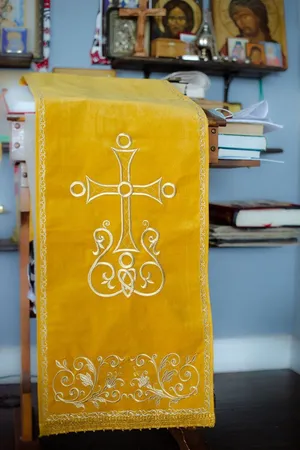
Chalice Covers
80 items


Our chalice cover sets are made to match the season and the rest of your altar — the aer (the large outer veil), the smaller diskos veil, and the chalice veil are sewn from the same brocade and finished with hand-embroidered crosses, icons, or liturgical inscriptions. Every set is made in our Florida atelier; sizes are customised to fit your specific chalice and paten.
Whether you're outfitting a newly consecrated altar or replacing a tired set, we work closely with rectors and church wardens to choose colours that complement existing vestments and altar coverings — gold for ordinary Sundays, red for martyrs and Holy Week, white for Pascha and Theophany, and more.
What a chalice cover set includes
The traditional Orthodox set consists of three pieces, each with a specific role at the Liturgy:
- The aer — the largest of the three, draped over both the chalice and the diskos before the Great Entrance and waved over the Gifts during the Creed. Symbolically, it represents the stone rolled away from the tomb. Typically square (60×60 cm / 24×24″) with a cross or icon of the Lamb in the centre.
- The diskos veil — covers the paten (diskos) carrying the prepared Lamb. Usually around 35×35 cm (14×14″) with a smaller central icon or cross.
- The chalice veil — covers the chalice itself, sized to drape over a standard chalice with comfortable overhang. Often embroidered with a cross over the cup or the Lamb on a paten.
How chalice cover sets are used in the Liturgy
At the Proskomedia (the preparation of the Gifts before the Liturgy), the priest covers the diskos with its small veil, then the chalice with its veil, and finally drapes the aer over both. The veils stay in place through the Great Entrance, when the deacon (or a second priest) carries them in procession. They are removed during the Creed and the aer is held over the Gifts and waved gently during the Creed and the Anaphora.
Because the aer is moved through the air and handled often, it needs to be both beautifully made and physically robust — embroidery must not catch on the chalice rim, and the fabric must drape cleanly without stiffness or sag.
Materials and embroidery
We use the same brocade weights as our phelonion vestments, lined with soft cotton or silk so the veils drape correctly and don't damage the chalice rim. Embroidery is done in metallic gold or silver thread depending on the season; for premium sets we offer raised goldwork on the central panel (the technique used on antique sets in the great monasteries of Mount Athos and the Russian North).
Choosing colour and design
A chalice cover set follows the liturgical calendar in the same way as priest vestments. Most parishes order their first set in gold, then add a red or burgundy set for Holy Week and feasts of martyrs. White (for Pascha, Theophany, the Nativity) and blue (for feasts of the Theotokos) are common third and fourth sets. We can match an existing altar set or vestments — send us a photograph and we'll find the closest brocade.
Sizing for your specific chalice
Standard chalice cover sizes work for most North American and European chalice and paten dimensions, but goldsmith-made chalices can vary considerably. When you order, please send us the height of your chalice from base to rim, the diameter of the cup, and the diameter of your paten. We'll size the set to fit.
Frequently asked about chalice covers
What is the difference between an aer, a diskos veil, and a chalice veil?
The aer is the large outer veil, draped over both the chalice and the diskos at the Proskomedia and waved over the Gifts during the Creed and Anaphora. The smaller diskos veil covers the paten (diskos), and the chalice veil covers the chalice itself. All three are made from matching brocade and embroidered to match the liturgical season.
What sizes are your chalice cover sets?
Our standard aer is 60×60 cm (24×24″), diskos veil 35×35 cm (14×14″), chalice veil sized to drape over a standard chalice with about 10 cm (4″) overhang on each side. We adjust to your exact chalice and paten dimensions when you order — please send us cup diameter, paten diameter, and chalice height.
Can you embroider an icon on the aer?
Yes. Most aers feature either a cross, an icon of the Lamb (Christ as the sacrificial lamb), or an icon of the Burial of Christ in the centre. We can also embroider parish-specific designs — the patronal feast of your church, for example. Lead time for fully embroidered icon panels is typically 6–8 weeks.
How do I clean a chalice cover set?
Hand-spot-clean fresh stains with a damp white cloth and a tiny amount of mild soap if needed; for thorough cleaning, dry-clean only, with a cleaner who works with liturgical textiles. Never machine-wash or tumble-dry — the embroidery will be damaged. Between uses, store flat in a clean drawer or hung in a garment bag, away from direct sunlight.
What colours do chalice cover sets come in?
We make sets in all the traditional liturgical colours: gold (most Sundays), white (Pascha, Theophany, Nativity), red (martyrs, Holy Week in Slavic practice), blue (Theotokos), green (Pentecost, Palm Sunday), purple (Great Lent, the Cross), and black (Great Lent weekdays, funerals). We can also match a specific shade you provide.
Do you make matching altar covers and analogion covers?
Yes — many parishes order a full coordinating set: chalice covers, altar cover, analogion (lectern) cover, and a banner for the patronal feast, all in the same brocade. Ordering them together ensures the colours match exactly. See our altar covers and analogion covers categories.
How long does a chalice cover set last with regular use?
With reasonable care a set lasts 15–20 years of weekly use. Embroidery in metallic thread can darken slightly over time, which most parishes find adds character. We can re-embroider the central panel onto fresh brocade as a restoration when the original fabric wears out.