Walk through a vestment exhibition in any Orthodox jurisdiction and you'll see two kinds of embroidery on the phelonions and altar covers on display: hand-embroidered pieces, including the traditional goldwork technique that has been practised in Orthodox workshops for over a thousand years, and machine-embroidered pieces, produced on computer-driven embroidery machines in the past few decades. To the casual eye the two can look similar. To the trained eye they are immediately distinguishable. To the candlelight of an actual Orthodox liturgy, they read quite differently.
This article walks through the practical difference between hand and machine embroidery on liturgical vestments — what each looks like up close, how much each costs, how each holds up over decades of use, and when it makes sense to pay for hand embroidery rather than machine.
Three Levels of Vestment Embroidery
Modern vestments are made at one of three levels, with very different price points and visual results:
- Fully machine-embroidered. The brocade is machine-loomed, all decorative trim is machine-applied, all icon panels and crosses are machine-stitched. The lowest-cost option; commonly sold for around $200–500 per phelonion.
- Semi-hand (machine body + hand icon panel). The phelonion body, trim, and minor embroidery are machine-applied, but the central icon or cross panel is hand-embroidered, often goldwork. The most common quality level for serious parish commissions; $800–1,800 per set.
- Fully hand-embroidered. Every panel, trim, and inscription is worked by hand. The traditional craftsmanship of antique Orthodox vestments. Reserved for premium commissions, episcopal sets, and patronal-feast pieces; $2,500–5,000+ per set.
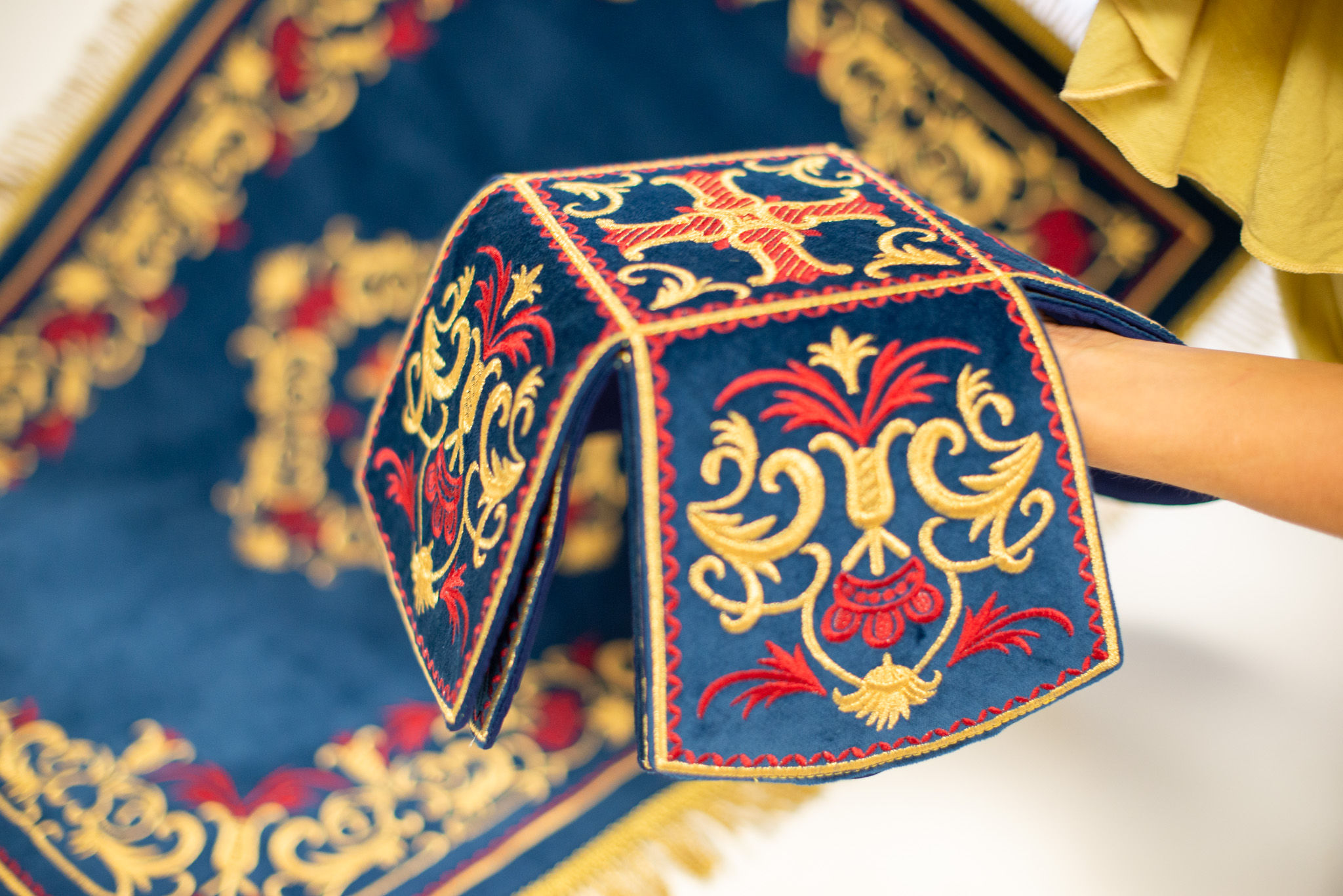
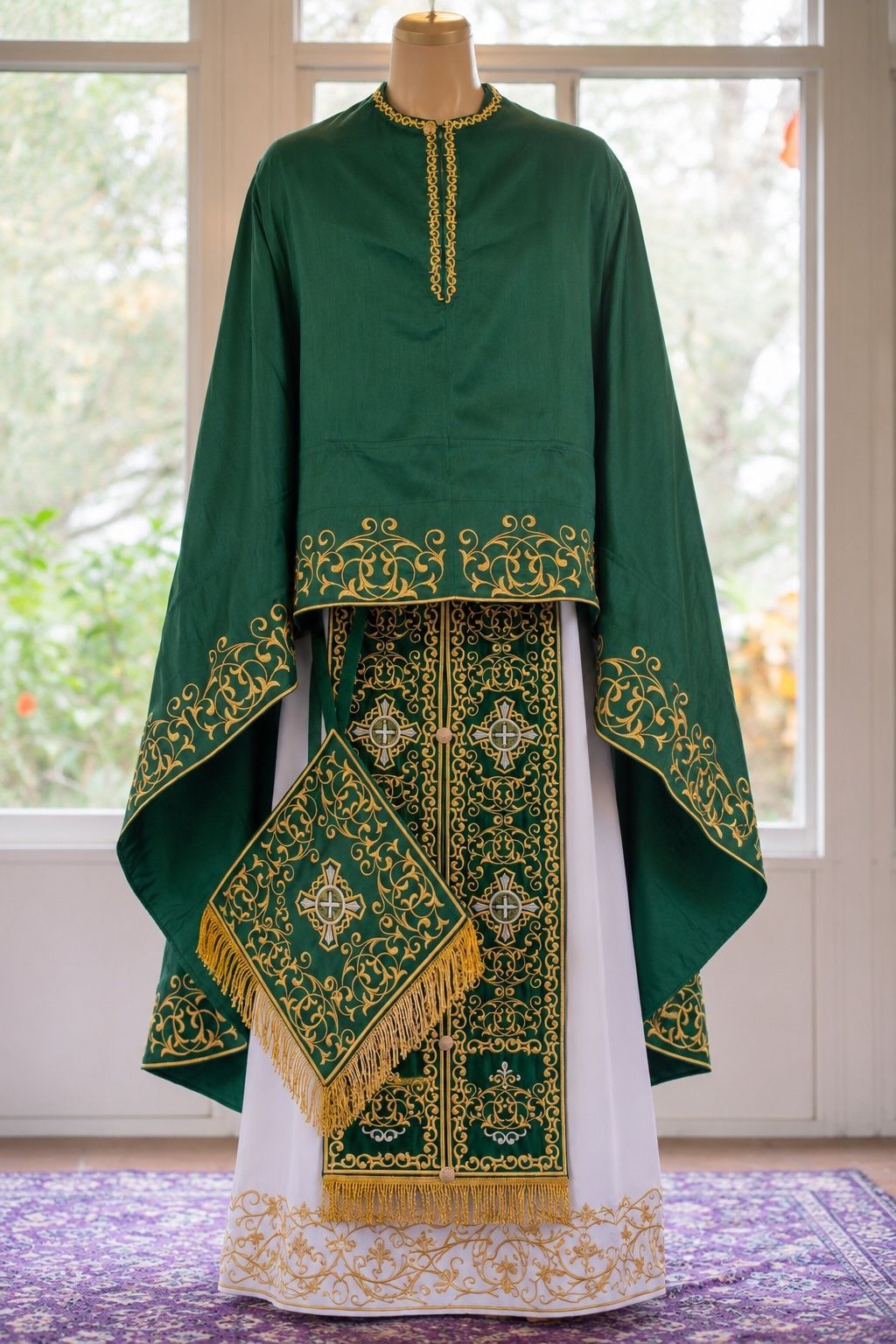
Our own vestments are machine-embroidered: the panels, trim and inscriptions are stitched on professional embroidery machines in our Florida atelier, and every piece is then finished by hand, from tassels and fringe to linings and a final inspection. That keeps fully embroidered vestments at a price most parishes can afford.
What Machine Embroidery Looks Like Up Close
Machine embroidery, even at its best, has telltale visual signatures:
- Uniform stitch length. Every stitch is exactly the same length and angle, set by the embroidery machine's pattern file. The eye reads this as "even," but in a slightly off-putting, mechanical way.
- Flat surface. Machine embroidery sits at one level on the fabric. There is no raised or padded element to catch the light.
- Slightly plasticky finish on metallic thread. Machine-friendly gold and silver thread is wrapped around a polyester core. It catches light, but the catch is uniform — almost too uniform.
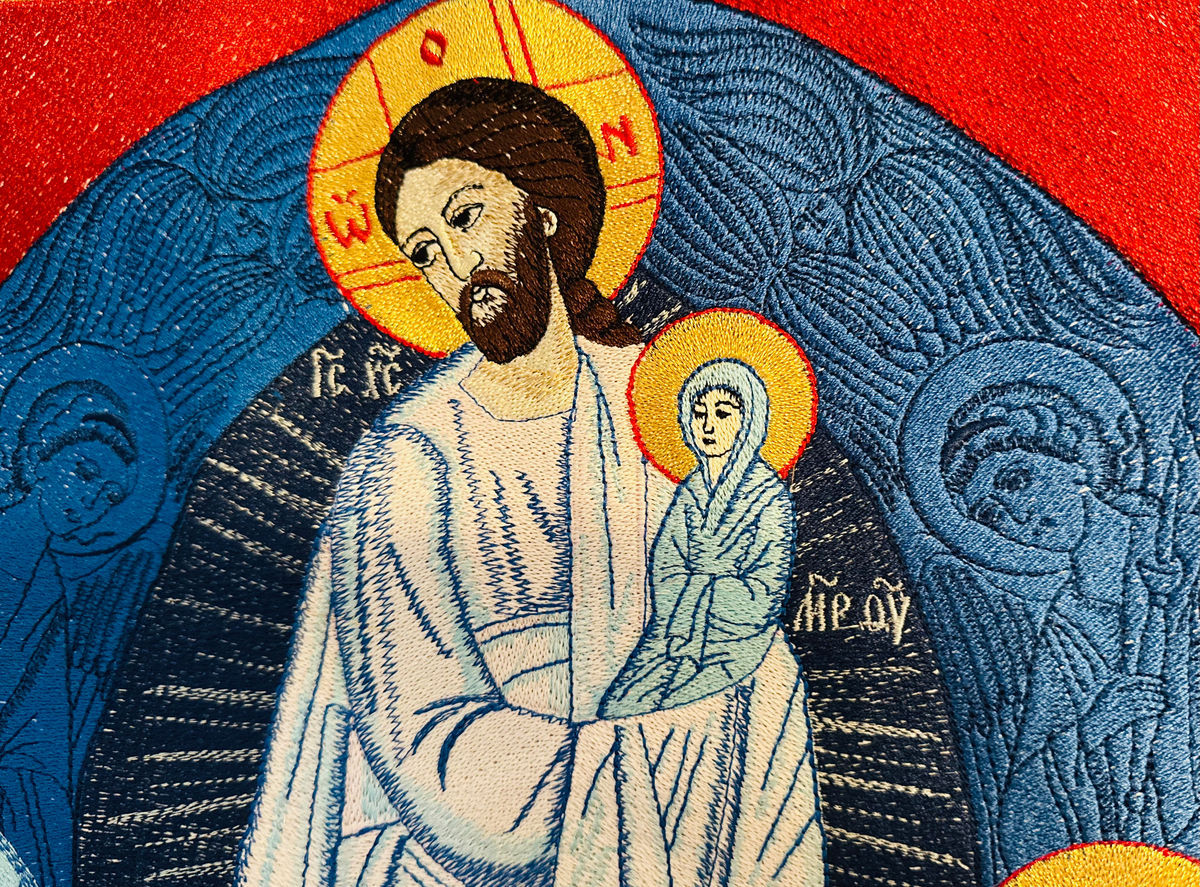
- Visible "fill" patterns. When a machine fills in a large area (like the field of an icon), it does so in regular sweeping lines. Up close you can see the back-and-forth path of the needle.
- Sharp, identical edges. Every cross, every halo, every letter has crisp identical edges — because they were drawn once on a computer and stitched the same way every time.
Machine embroidery is appropriate for vestments that need to be produced at scale and affordable. There is no shame in it. A parish that can afford a machine-embroidered gold set is far better off than a parish without vestments at all.
What Hand Embroidery Looks Like Up Close
Hand embroidery shows the work of a human hand in every dimension:
- Subtle stitch variation. No two stitches are perfectly identical. The eye reads this not as "uneven" but as "alive."
- Raised goldwork. The traditional Byzantine technique pads the embroidered area with felt or twisted cord beneath the gold thread, so the embroidery stands up off the fabric by 2–4 mm. This is the single most distinctive visual signature of high-quality liturgical embroidery — and it is impossible to reproduce by machine.
- The catch of candlelight. Because raised goldwork has dimension, it reflects candlelight from different angles at different times. As the priest moves at the altar, the embroidery seems to shimmer. Machine embroidery, being flat, looks the same from any angle.
- Visible thread direction. In hand goldwork, the embroiderer chooses the direction of each gold thread to emphasise the form — vertical along an arm, horizontal across a halo, radiating from a centre. This deliberate direction makes the surface of the embroidery feel sculptural.
- Real silver and real gold. Premium hand embroidery uses thread spun around a silver-gilt core. It tarnishes slowly over decades — which many find adds character. Modern machine thread does not tarnish but also does not patina.
Hand embroidery is the technique used on the great antique vestments in the Patriarchal Sacristies, on Mount Athos, in the Russian monastic treasuries. It is what people mean when they speak of "real" liturgical embroidery.
Cost, Lead Time, and Durability Compared
| Aspect | Fully machine | Semi-hand | Fully hand |
|---|---|---|---|
| Price (phelonion set) | $200–500 | $800–1,800 | $2,500–5,000+ |
| Lead time | 2–3 weeks | 6–10 weeks | 3–6 months |
| Expected life (regular use) | 8–15 years | 15–25 years | 30–50+ years |
| Restorable? | Difficult — the machine pattern can't be matched exactly when replaced | Yes — hand-embroidered panel can be re-mounted onto new brocade | Yes — hand-embroidered panels can be transferred to new bases multiple times across the life of the embroidery |
When to Pay for Hand Embroidery
Hand embroidery is not always the right answer. It is the right answer when:
- The vestment is for a major commission — an ordination, a parish patronal feast, an episcopal consecration, a parish centenary.
- The vestment will see decades of use. A gold workhorse set worn 30+ times per year for 20 years amortises hand embroidery's higher price across so many uses that it actually becomes the cheaper option per Liturgy.
- The iconography matters specifically — the patronal saint, an icon panel that the parish particularly venerates, a personal monogram. Hand embroidery allows the iconographer to consult on the design; machine embroidery is bound to whatever digital file was prepared.
- The vestment is meant to last beyond the priest who orders it. Many parishes treat their patronal-feast vestments as multi-generational pieces — passed from one priest to the next over decades. Hand-embroidered work can outlast the brocade itself, and the embroidered panels can be re-mounted onto new fabric when the original wears out. Machine embroidery cannot.
For everyday gold sets, second-colour Lenten sets, deacon sets at a small parish, and most working vestments — semi-hand quality (machine body + hand icon panel) is the right balance of cost and craftsmanship. Pure machine work is appropriate when budget is the binding constraint.
Why Some Workshops Still Do It By Hand
Workshops that still embroider by hand give three reasons for it:
The first is craftsmanship as continuity. Hand embroidery in the Orthodox tradition is sixteen centuries old. Every major sacristy in the Christian East holds antique vestments whose embroidery was done by hand by named or anonymous craftspeople who learned the technique from someone who learned it from someone before. If our generation stops, the next generation cannot pick it back up — the technique is not preserved by books, it is preserved by apprenticeship.
The second is theology. Liturgical embroidery is itself a form of prayer for the embroiderer. The hours spent over a chalice cover or a phelonion icon panel are not "work" in the ordinary sense — they are time spent inside the iconography, attending to the holy things the embroidery depicts. Machine work cannot do this, however beautifully it reproduces a final image.
The third is durability. A phelonion icon panel embroidered by hand in 2026 will, with reasonable care, still be in use in 2076. Two priests can serve in the same icon over two generations.
What to Ask When Commissioning
If you are considering a commission and quality matters, ask the workshop directly:
- "Is the central icon hand-embroidered? Can I see photographs of it being worked?"
- "Is the goldwork raised, or is it laid flat on the fabric?"
- "What kind of thread is the goldwork — silver-gilt, gilt-coated polyester, or plain polyester with metallic finish?"
- "How long will the central panel take?"
- "Can the embroidered panel be removed and re-mounted onto new fabric in the future?"
A workshop that hand-embroiders can answer all five clearly. One that doesn't will hesitate.
Our vestments are machine-embroidered and finished by hand. To see the work up close, browse our priest vestments category or contact us for a custom commission; we are glad to send detailed photographs before you order.