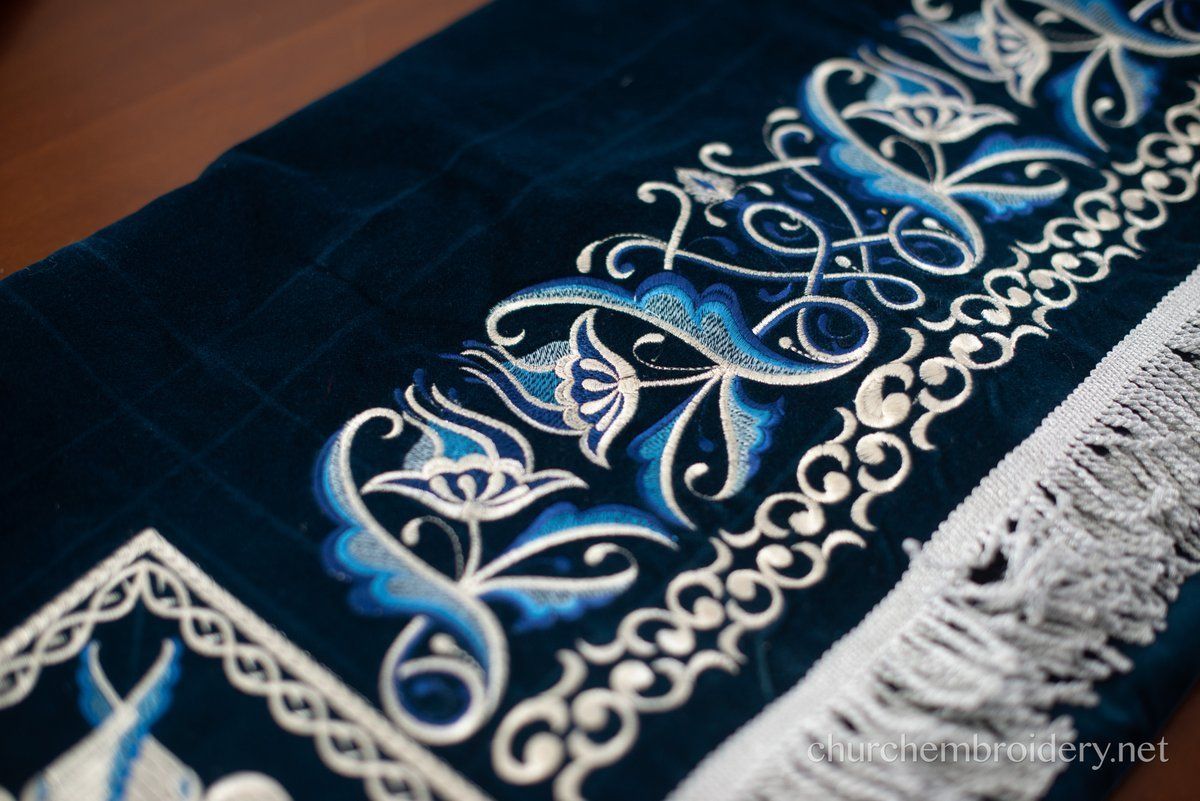
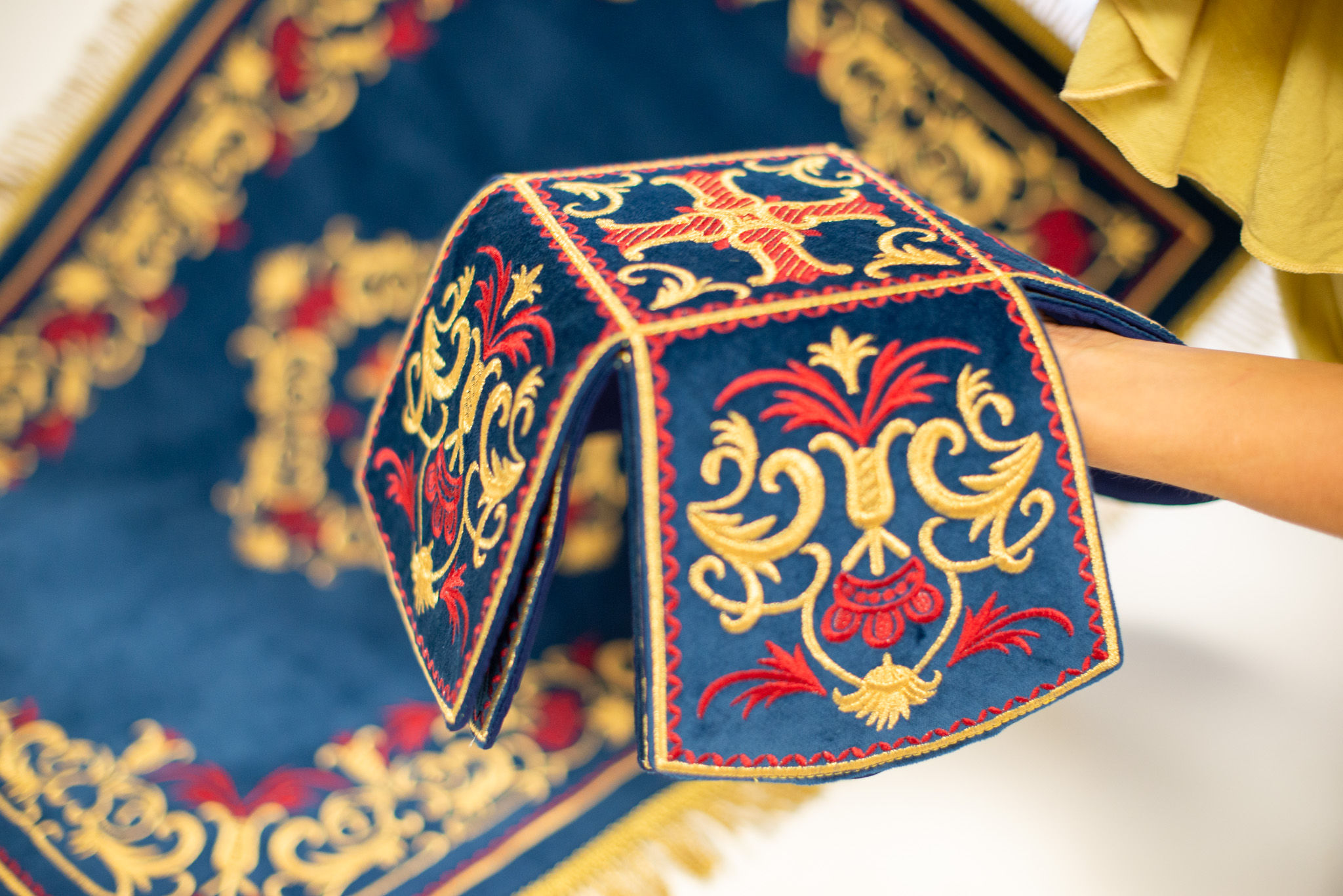
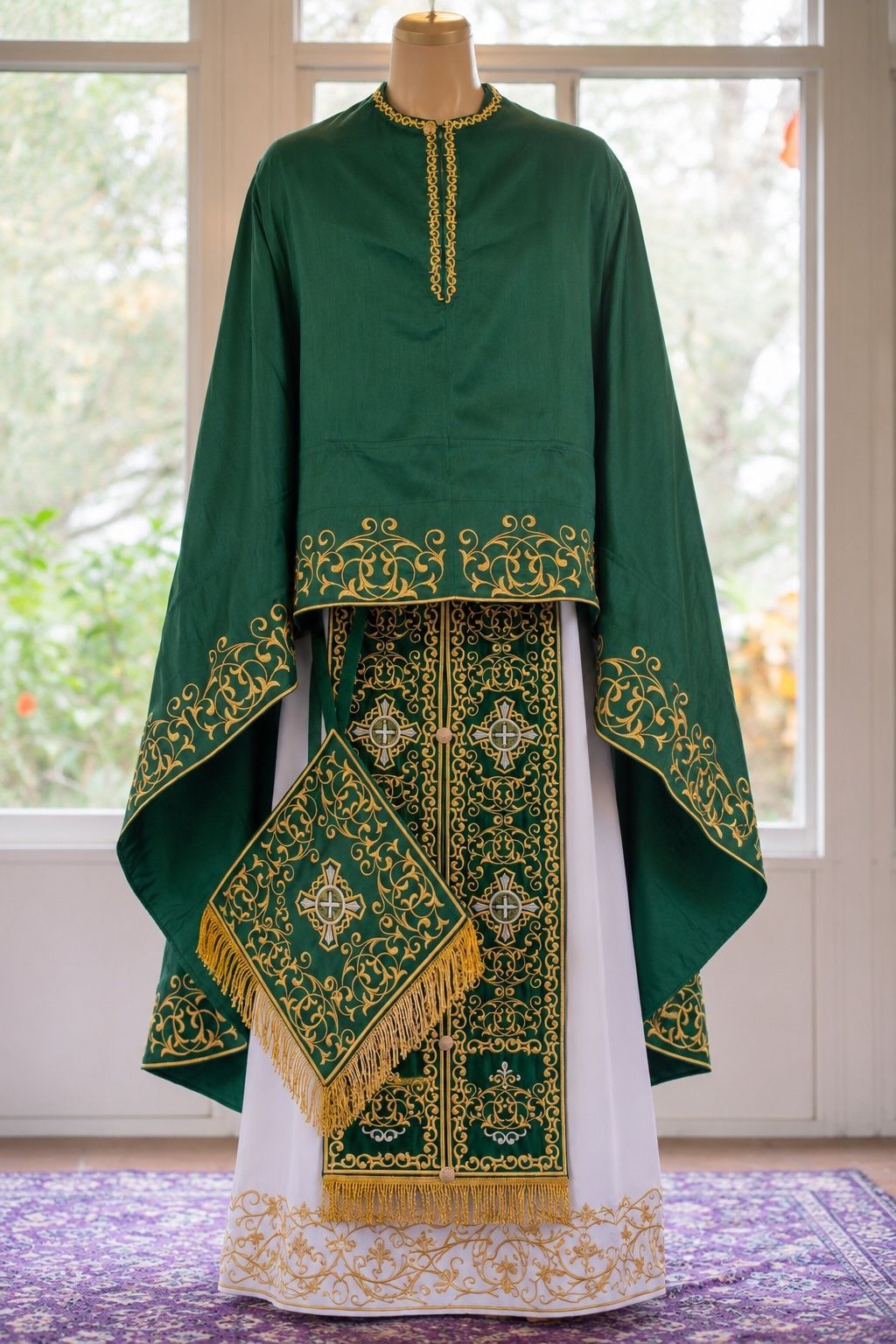
If you watch an Orthodox parish across a year, the colours of the vestments change like the seasons. Gold for most of the year. White for Pascha. Red for Holy Week in some places, green in others. Blue when the Theotokos is celebrated. Purple in Lent. Black at funerals. The pattern is consistent enough to be a calendar and free enough to vary from parish to parish.
This article walks through the seven traditional liturgical colours of the Orthodox Church, what each one is used for, and where Greek and Slavic practice diverge. It is not the final word — local tradition matters — but it will let you understand what you're seeing on any given Sunday.
The Underlying Logic
Before the colours themselves: a note on how the Orthodox calendar of colours works.
Unlike the Roman Catholic post-Vatican-II calendar, which standardised liturgical colour rigidly across the world, Orthodox practice is older and more fluid. There is no canonical list of colours-per-feast issued by any synod. What we have instead is centuries of converging tradition, with small but real variations between Greek, Slavic, Romanian, and other practices.
Two principles run through all of them:
- Solemnity: the greater the feast, the brighter and lighter the colour. White and gold for the highest feasts; darker tones for ordinary and penitential days.
- Theme: within solemnity, particular colours signal particular subjects — red for blood (martyrs), blue for the Virgin, green for life (Pentecost).
Most parishes have a working set of two to four colours and expand as they can afford to. To browse vestments in any colour, see our priest vestments category — the colour is chosen at the time of order.
1. Gold — The Default Colour
Gold (sometimes called yellow) is the working colour of most Orthodox parishes. It is worn on:
- Every ordinary Sunday of the year — what is sometimes called the "Sundays of the year" outside of fasting seasons
- Feasts of the Lord that don't have a specific colour assigned: the Circumcision, the Transfiguration (in many traditions)
- Feasts of saints whose specific colour isn't otherwise marked
The reason gold dominates is practical. A parish that can afford only one set of vestments orders gold, because it covers the largest portion of the year. The colour is also theologically appropriate to ordinary time: gold is the colour of divine glory, the colour of the icons' background, the colour of the candlelight in the sanctuary.
2. White — Pascha and the Brightest Feasts
White is reserved for the most luminous days of the liturgical year:
- Pascha — Easter night and Bright Week. The entire week after Pascha, services use white.
- Theophany (the Baptism of Christ, 6 / 19 January) — celebrating the revelation of the Trinity at the Jordan.
- The Nativity of Christ in many traditions (gold is also used).
- The Transfiguration (6 / 19 August) — the day Christ's garments themselves "became white as the light."
- Funerals in Greek practice — white is the colour of the resurrection, and a funeral is the soul's Pascha.
- Weddings in some traditions.
White vestments are often woven from a brocade that includes silver thread rather than gold, which gives them a cooler, more brilliant tone in candlelight. Some parishes use "silver" sets that are really white-brocade-with-silver-embroidery and serve interchangeably with pure white.
3. Red — Martyrs, Holy Week, and the Cross
Red has the most variation between Greek and Slavic practice.
In Greek and Mediterranean traditions, red is the colour of:
- Feasts of martyrs (red for the blood of martyrdom)
- The Apostles, especially Saints Peter and Paul (29 June / 12 July)
- Some feasts of the Cross — though purple is also used
In Slavic traditions, red plays a much larger role. It is the colour of:
- All of Holy Week through Great and Holy Saturday (where it expresses the blood of Christ's Passion)
- The Sunday of the Myrrh-Bearers
- All martyrs' feasts
- The Apostles
- Some parishes also use red through Pentecost season in commemoration of the apostolic mission
The reasoning differs: in Greek practice red is specifically the colour of blood (and so reserved for martyrs and the Passion); in Slavic practice it expanded to cover all of Holy Week as the colour of suffering love. Both are theologically sound; they just made different choices around the seventeenth century.
4. Blue — Feasts of the Theotokos
Blue — usually a deep marian blue, sometimes light sky blue — is the colour of feasts of the Mother of God:
- The Nativity of the Theotokos (8 / 21 September)
- The Entrance of the Theotokos into the Temple (21 November / 4 December)
- The Annunciation (25 March / 7 April)
- The Dormition (15 / 28 August)
- All other Marian feasts and Sundays specifically dedicated to her
Blue is a relatively young colour in Orthodox use — it became consistent only in the eighteenth and nineteenth centuries — but it has caught on universally in Slavic, Greek, and Romanian practice today. Earlier Marian feasts were often celebrated in white or gold.
Many parishes order a Theotokos set early — usually after gold and one penitential colour — because she is celebrated so often through the year.
5. Green — Pentecost, the Cross, and Monastic Saints
Green is the colour of life, of the Holy Spirit descending on the green branches of the Pentecost decorations, and of the monastic life lived in the wilderness. It is worn on:
- Pentecost Sunday and Bright Monday (Monday of the Holy Spirit) — in most traditions
- Palm Sunday — the day branches were strewn before Christ
- Feasts of monastic saints — Saint Anthony the Great, Saint Mary of Egypt, Saint Sergius of Radonezh, Saint Seraphim of Sarov, and other ascetics and elders
- Some feasts of the Cross (alternating with red and purple)
The link between green and monasticism is ancient: the desert fathers withdrew to live in literal wildernesses, and green came to symbolise the spiritual life that flourishes outside the cultivated world.
6. Purple — Great Lent and the Cross
Purple (sometimes "violet" or "dark red" depending on the brocade) is the colour of penitence and royal sorrow. In Orthodox use it covers:
- Sundays of Great Lent — the six Sundays of Lent (sometimes called "Sundays of the Triodion") through Lazarus Saturday
- Feasts of the Cross — the Universal Exaltation of the Cross (14 / 27 September), the Sunday of the Cross in Lent, the Procession of the Cross on 1 / 14 August
- The Forefeast and Apodosis of major feasts when those fall in Lent
The colour echoes the royal purple of Pilate's mock-king robe placed on Christ before His Passion — combining penitence with the recognition of Christ as the suffering King.
Lent weekdays in Slavic tradition are often celebrated in black rather than purple (see below); in Greek tradition purple covers both Sundays and weekdays of Lent.
7. Black — Great Lent Weekdays, Funerals, Holy Friday
Black is the most penitential and mourning colour. It is worn on:
- Great Lent weekdays in Slavic practice (purple is used for Sundays)
- Holy and Great Friday in many traditions
- Funerals in Slavic practice (white in Greek practice)
- Memorial services and certain commemorations of the departed
Black is the only colour the Orthodox Church uses in pure mourning. It is a relatively late liturgical colour — older Russian practice used purple for Lent through the seventeenth century, with black coming in under Western influence — but it has been universally adopted since then in Slavic parishes.
A Year in Colour: The Working Calendar
Putting it all together, a parish that owns a complete set of seven colours moves through the year roughly like this:
- September – November: mostly gold, with blue interludes for Theotokos feasts and red for the Apostles' feasts.
- December – early January: gold or white for the Nativity (24 December / 6 January), white for Theophany (6 / 19 January).
- January – February: gold returns, with red for the feast of the Three Holy Hierarchs (30 January / 12 February) and blue for the Meeting of the Lord (2 / 15 February).
- Great Lent (Mon–Sat): black (Slavic) or purple (Greek); Sundays of Lent: purple.
- Holy Week: red (Slavic, all week) or purple/black (Greek, Holy Friday specifically black; rest of Holy Week varies).
- Pascha + Bright Week: white.
- Sundays after Pascha: white through the Sunday of the Myrrh-Bearers (some parishes red here), then gold.
- Pentecost: green.
- Summer: gold most weeks; blue for the Dormition cycle (August); white for the Transfiguration (6 / 19 August).
Building a Set: Order of Priorities
If you're outfitting a parish, the most useful order of acquisition is:
- Gold — covers most of the year.
- Purple or black — for Great Lent and Holy Week.
- White — for Pascha and the great feasts.
- Red — for martyrs and (Slavic) Holy Week.
- Blue — for the many Theotokos feasts.
- Green — for Pentecost and the monastic saints.
Most parishes take ten to fifteen years to acquire a full set; some never get past four or five colours. There is no shame in that. What matters is that the colour, whatever it is, is worn with intention.
For commissioning vestments in any colour, see our priest vestments and altar covers categories. We work with parish wardens to match the colour of an existing set, or to build out a coordinated sanctuary across multiple textiles.
One Last Word
Liturgical colour is a kind of slow catechesis. A child who grows up in an Orthodox parish learns, without being told, that Pascha is white and Lent is dark, that the Mother of God means blue, that martyrs mean red. Those associations sit deeper than any sermon. They become the visual rhythm of the year — the way the seasons are felt by the eye, not just the ear. Which is why getting the colours right matters: not as a checklist, but as a way of teaching the faith without speaking.