Of all the objects in an Orthodox church, the antimins is one of the least visible and one of the most important. It rests folded on the Holy Table beneath the Gospel book, unfolded only at specific moments of the Divine Liturgy. The congregation rarely sees it. Most lay people don't know what it is. Yet without an antimins, no Orthodox priest can celebrate the Divine Liturgy. Every parish church, every monastery chapel, every army field-chapel, every cemetery chapel — all have an antimins.
This article explains what the antimins is, where it came from, what is sewn inside it, how it functions during the Liturgy, and why it occupies the central place it does in the architecture of Orthodox worship.
What an Antimins Is
An antimins (Greek: antimension, "instead of the table") is a rectangular piece of linen or silk, roughly 50×60 cm (20×24 inches), depicting the Burial of Christ in its central panel — the Lord laid in the tomb, the Mother of God and the disciples grieving, angels above. Around the central image are smaller icons of the four Evangelists at the corners and inscriptions in Slavonic, Greek, Romanian, or English depending on the jurisdiction.
Three features distinguish an antimins from any other liturgical textile:
- It is consecrated by a bishop, not by a priest. Antimins are signed and sealed at the moment of consecration by the bishop of the diocese; a parish receives its antimins from its bishop's hand or by direct grant.
- It contains relics. Sewn into a small pocket on the back, between the linen and a backing layer, is a fragment of the bone of a saint — usually a martyr. These relics are obtained by the bishop from older antimins, from his cathedral's relic collection, or from monastic sources.
- It carries the signature of the bishop who consecrated it, the date, and the parish or chapel it was issued to. The signature is in the bishop's own hand, in ink, near the bottom edge.
Without these three features — episcopal consecration, sewn relics, hand-written signature — a cloth is not an antimins.
The Eilethon: The Cloth That Wraps the Antimins
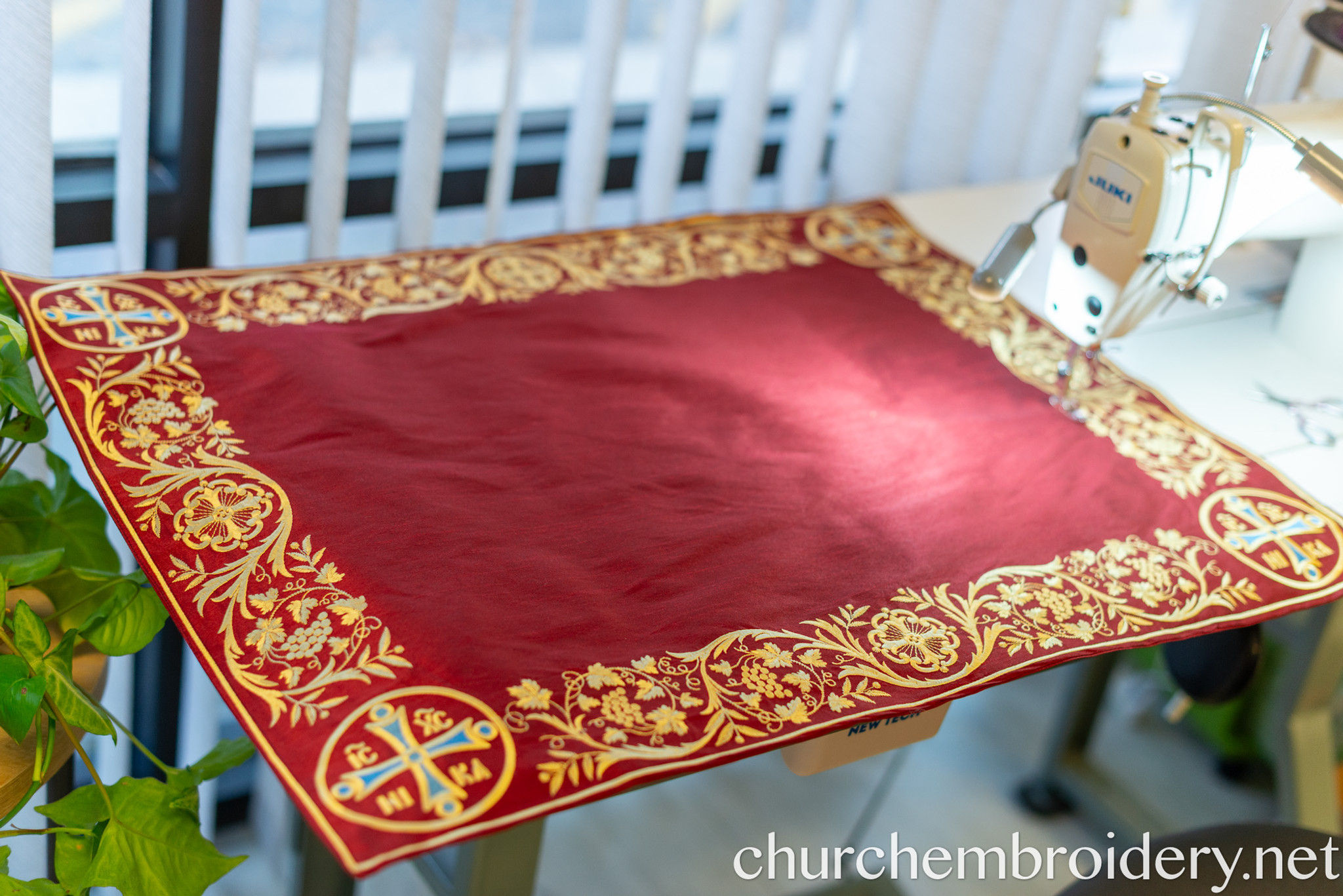
The antimins is always kept folded, wrapped inside a slightly larger square of plain silk or linen called the eilethon (Greek for "wrapping"). The eilethon protects the antimins from wear, candle wax, and the everyday handling of the Holy Table. Many parishes have a beautifully embroidered eilethon — the eilethon is the visible cloth, while the antimins inside is the one with the real liturgical function.
The pair — antimins inside, eilethon outside — rests on the Holy Table beneath the Gospel book whenever the Liturgy is not being served. Both stay there permanently.
The History of the Antimins
The antimins as we know it is a relatively young object — its modern form emerged in the late Middle Ages — but its function is ancient.
In the earliest centuries of the Church, the Liturgy was often celebrated on the tombs of martyrs in the catacombs of Rome and the cemeteries outside the great cities. The link between the Eucharist and the martyr's grave was direct: the altar literally rested on the bones of those who had died for Christ. As the persecutions ended and church buildings became permanent, the practice continued: every consecrated altar contained relics, sealed into the stone of the Holy Table at consecration. Without the relics beneath, the altar was not a place for the Eucharist.
This created a problem when the Liturgy needed to be celebrated outside of consecrated buildings — in army camps, in private homes, on missionary expeditions, in newly founded churches before consecration was possible. The solution emerged gradually from the eighth century onward: a portable consecrated cloth, containing relics, that could be unfolded on any clean surface and turn it into a momentary altar. The antimins.
By the eleventh and twelfth centuries the antimins had become standard equipment in churches as well as in mission settings. By the seventeenth century the modern form had stabilised — printed icon of the Burial of Christ, four evangelists at the corners, bishop's signature, sewn relics.
Today, even in churches with fully consecrated altars containing their own relics in stone, the antimins is always present, always unfolded for the Liturgy. The cloth has become inseparable from the rite.
The Antimins in the Liturgy
The antimins comes into use at a specific moment of every Divine Liturgy. After the Liturgy of the Catechumens, just before the Great Entrance:
- The deacon (or the priest, if no deacon is serving) unfolds the antimins on the Holy Table. The wrapping eilethon is folded back to the left.
- The antimins now lies flat in the centre of the altar, with the icon of the Burial of Christ visible. The Lamb (the prepared eucharistic bread) is brought from the table of oblation and placed on the diskos at the centre of the antimins.
- The chalice is placed beside the diskos, also on the antimins.
- The remainder of the Liturgy — the Great Entrance, the Anaphora, the consecration, the communion — happens with the Gifts resting on the antimins.
- After communion and the dismissal, the deacon folds the antimins back, wraps it in the eilethon, and replaces both beneath the Gospel book.
The choice of icon — the Burial of Christ — is theologically pointed. The Holy Table is symbolically the tomb of Christ; the antimins makes this explicit. The Gifts rest on the icon of His burial; the consecration happens above His burial shroud, in image; the communion of the faithful is communion in the death and resurrection that the icon depicts.
What Is Sewn Inside
The relic pocket of the antimins is a small sewn compartment, typically along the bottom edge or in the centre of the back. The contents are not visible from the front. Traditionally the pocket holds:
- A fragment of bone of a martyr or other saint — often a saint of particular significance to the bishop's diocese or to the parish receiving the antimins.
- Occasionally a small piece of cloth from the antimins of a previous bishop, or from the relics of multiple saints sewn together.
- A small piece of wax sealing the pocket, with the bishop's seal impressed.
The relics inside an antimins are not interchangeable with ordinary relics. They are specifically consecrated for liturgical use within that particular antimins, by the bishop who signed it. If an antimins is retired, the relics inside it are either returned to the bishop, transferred to a new antimins by him, or buried under the altar of the church where the antimins served.
When an Antimins Is Replaced
An antimins serves a parish for decades, sometimes more than a century. It is replaced when:
- The bishop who signed it has reposed, and the new bishop wishes to issue his own. This is the most common cause of replacement, though not strictly required — many antimins outlast multiple bishops.
- The cloth has worn out. Antimins are made of linen or silk and after fifty or seventy-five years of weekly unfolding and refolding they fray at the creases.
- The relics have been damaged — by water, fire, or other accident.
- The parish has been newly consecrated as a permanent church and receives a new antimins to mark the occasion.
An old antimins is never thrown away. It is burned respectfully, with the ashes buried, or it is preserved as a relic in the diocesan cathedral's archives. The relics from within are transferred carefully to a new antimins.
Why the Antimins Matters
The antimins is the visible link between the modern Orthodox parish and the early Christian Church of the catacombs. Every priest who celebrates the Divine Liturgy in 2026 places the Gifts on an icon of the burial of Christ, with a fragment of a martyr's bone sewn into the cloth beneath. The same connection that the second-century Christians made — that the Eucharist is offered on the bones of those who died for Christ — is preserved in this small piece of cloth on every Holy Table in the world.
It is also the visible link between the parish and the bishop. A priest cannot consecrate an antimins. He receives it from his bishop, signed by the bishop's hand. To celebrate on an antimins is to celebrate in communion with the bishop who gave it, and through him with the apostolic succession back to the apostles themselves. The antimins is, in this sense, the bishop's letter of commendation to every Liturgy in his diocese.
Receiving or Replacing an Antimins
If your parish is being newly consecrated, or your existing antimins has worn out, the process is straightforward: contact your diocesan bishop's office. Antimins are not commissioned from third-party workshops; they are produced under the bishop's authority, in church-supply houses approved by the diocese, and signed by the bishop himself before being given to the parish.
The eilethon — the protective wrapping — is a different matter. Eilethons can and should be replaced or upgraded by the parish: they are simply embroidered silk or linen squares, and a well-embroidered eilethon adds beauty to the altar even though it is not the liturgically central piece. To browse current altar textiles, see our altar covers category.