Walk into any Orthodox church on a feast day and you will see the clergy clothed in garments that look almost otherworldly — layered silks, gold thread, embroidered icons, deep crosses, woven trim. To a first-time visitor, these Orthodox vestments can feel like costume from another century. In a sense, they are. But the story of how they got there is more grounded, and more interesting, than most people expect.
This is a short history of where each piece of Orthodox priest vestments came from, why the Church kept them, and what they mean today — written for parishioners, choir directors, seminarians, and anyone curious about the craft.
1. The Apostolic Era: Ordinary Clothes for Sacred Service
In the first and second centuries, there was no such thing as a separate set of liturgical clothes. Bishops, presbyters, and deacons celebrated the Eucharist in the same long tunic and outer cloak that any educated Roman would wear to the marketplace or the courthouse. The clothing was clean, dignified, and white when possible — but it was not "vestments" in our modern sense.
The early Church inherited this from its Jewish-Roman context. Old Testament priests had elaborately prescribed garments (Exodus 28), but the New Testament priesthood deliberately did not copy them. Christ, the eternal High Priest, fulfilled the Temple service; the apostles did not need a second set of golden ephods to do what He had already done.
So for almost two hundred years, the clergy looked just like everyone else in church. What set them apart was their place at the altar, not the cut of their cloth.
2. The Third Century: When Sacred Clothing Was Set Apart
The first clear evidence of dedicated liturgical garments comes in the middle of the third century. Around the year 257 AD, Pope Stephen of Rome reportedly issued instructions that the clothes worn at the altar should not be used for any other purpose. They were not yet different in cut — they were the same long tunic and cloak Romans wore daily — but they were being set aside, washed carefully, kept in the sacristy, treated as holy.
This is the seed of everything that comes later. Once a garment is reserved for one purpose, that purpose begins to shape it. Within a few generations the Church began to choose finer fabrics for these clothes, then to embroider symbols on them, then to vary their form.
3. The Symbolic Reading Begins: Patristic Theology of Vestments
By the fourth century, when the Church emerged from persecution under Constantine, theologians began to read the vestments symbolically. St. Germanus of Constantinople (c. 715 AD) and later St. Symeon of Thessalonica (15th century) wrote detailed commentaries explaining what each piece signified:
- The sticharion — the white inner robe — represents the spiritual joy and purity required of one who stands at the altar.
- The epitrachelion (priestly stole) signifies the grace of priesthood, the “yoke of Christ” that the priest takes upon his shoulders.
- The phelonion (chasuble) recalls the seamless robe of Christ and the cloth in which the angels wrap the soul.
- The orarion, worn by deacons, traces back to the towel with which Christ girded Himself at the Last Supper to wash the apostles’ feet.
These readings did not invent the vestments. They came afterward, as the Church meditated on what she had already received and asked: why this, why now, what does it teach?
4. Byzantine Refinement: 6th to 9th Centuries
The biggest visual changes came during the Byzantine period. Outside the church, fashion was moving on — barbarian tribes had reshaped European dress, and the long Roman tunic disappeared from the street. Inside the church, the old form held. By the 9th century, what an ordinary man wore had nothing in common with what a priest wore at the altar. The vestments had not become "older"; the world had moved on around them.
This is also the era when liturgical embroidery reaches its first peak. Silk from Asia, gold thread spun in Constantinople, and the dedicated workshops of the imperial monasteries produced vestments of astonishing detail — whole icons embroidered onto the back of a phelonion, the Hospitality of Abraham worked into an epitrachelion in colored silks. Many of these pieces survive in monastery treasuries today.
5. The Names and the Shapes
The standard set of Orthodox clergy vestments took on roughly the form we know today by the 12th to 14th centuries. A quick guide:
For deacons
- Sticharion — a long, wide-sleeved tunic, usually with embroidered trim along the cuffs and hem.
- Orarion — a long narrow band of fabric worn over the left shoulder. The Greek tradition has the deacon’s orarion fall straight down, front and back. The Slavic tradition has him cross it under the right arm.
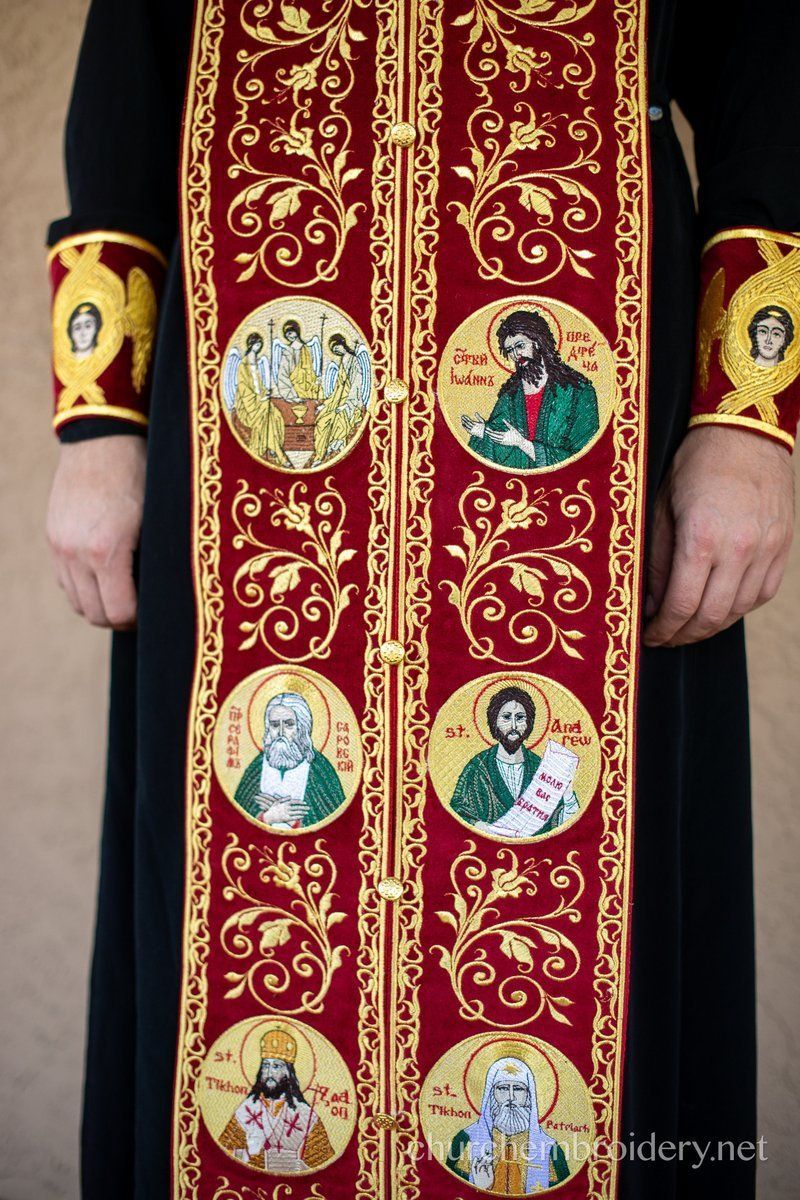
- Cuffs (poruchi, epimanikia) — embroidered bands tied around the wrists, signifying the bonds that bound the hands of Christ at His Passion.
For priests
- Sticharion — same as the deacon’s, but often plainer because most of it is covered.
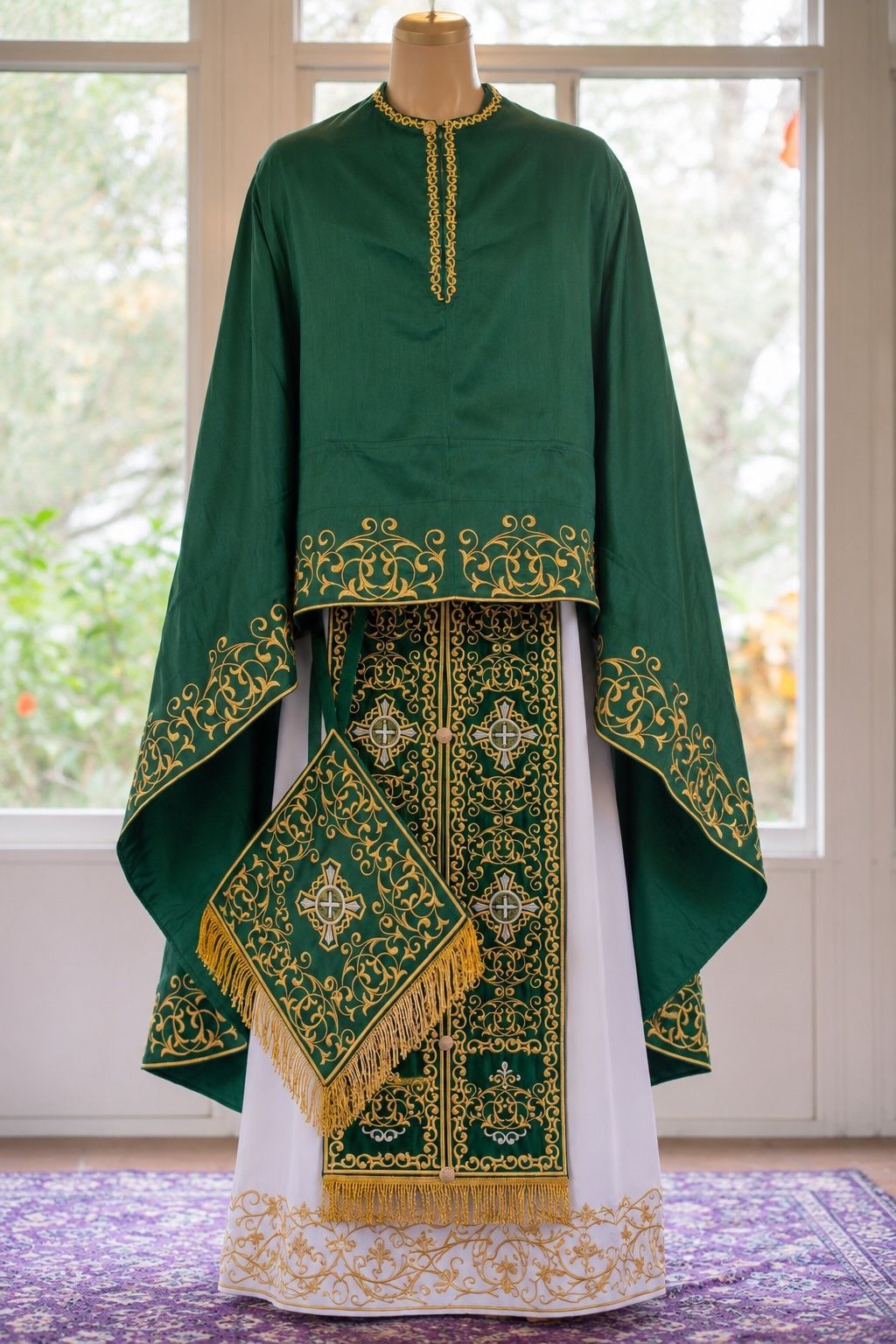
- Epitrachelion — the priestly stole, joined at the front, hanging straight down. Without it the priest cannot serve.
- Belt (zone) — literally a fabric belt; symbolically, the strength of God which girds the priest.
- Cuffs — same as the deacon’s.
- Nabedrennik — a rectangular embroidered cloth hung by one corner at the right hip. An honorary award given for service.
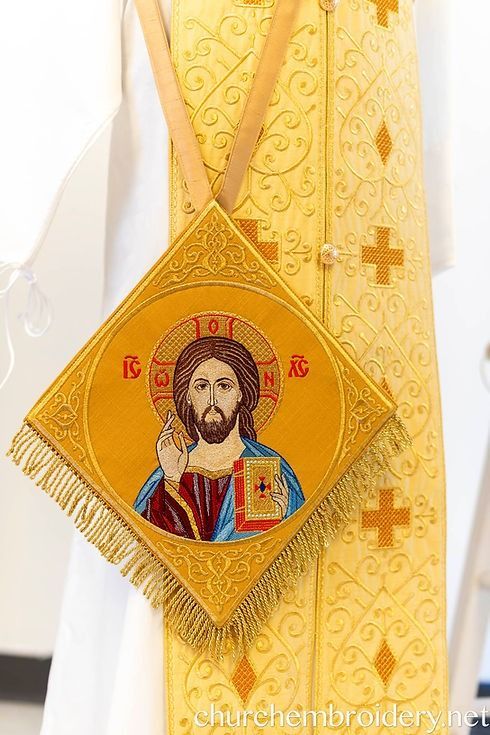
- Epigonation (palitsa) — a diamond-shaped embroidered cloth hung at the right hip. Symbolizes the “sword of the Spirit, which is the word of God.”
- Phelonion — the outer chasuble. In the Greek tradition cut higher in front; in the Slavic tradition, with a tall stiffened back.
For bishops
- Sakkos — a wide, sleeved overgarment that replaced the phelonion for hierarchs around the 14th century. Derived from a Byzantine imperial robe.
- Omophorion — a long wide band of fabric worn around the neck and shoulders, the great symbol of the bishop’s office — the shepherd carrying the lost sheep.
- Mitre — the crown of the bishop, recalling both the crown of thorns and the diadem of victory.
6. Continuity in the Modern Workshop
What is striking, when you study the history, is how little has changed in nine hundred years. The cut of an Orthodox priest’s phelonion made in Florida this year is essentially identical to one made in Thessalonica in the 14th century. The embroidery techniques — couched metal thread, padded gold, satin stitch over silk — were already mature when Andronicus II Palaiologos sat on the Byzantine throne. The icons embroidered on a modern epitrachelion are read from the same iconographic tradition that produced the Theodore Stratelates icons of the 10th century.
This continuity is not a museum exercise. It is the Church saying, with her clothing: what we do here at the altar is what was done before us, and what will be done after us. The same Eucharist. The same priesthood. The same vestments.
7. Why It Still Matters
For the clergyman vesting before liturgy, each garment carries a prayer. For the parishioner watching from the nave, the vestments are a sign that this is not ordinary time and not ordinary space. For the craftsman bent over a frame with a needle and gold thread, every stitch is a small act of confession that beauty belongs to God.
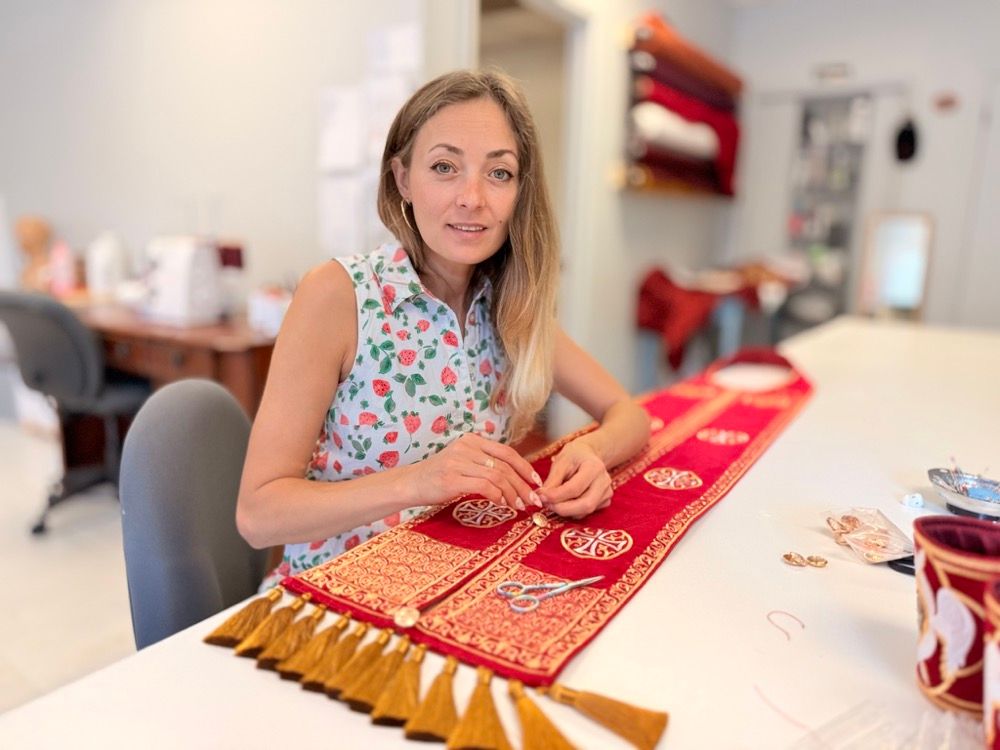
At our workshop we cut, sew, embroider and hand-finish every set of Orthodox vestments we make — priest sets, deacon sets, bishop sets, chalice covers, banners, and orarions — following the same patterns that have served the Church for centuries. We do this in the United States, for parishes across the Orthodox world.
If you are a priest, deacon, choir director, or parish council member looking for new vestments, you can browse our catalog or contact us about a custom set. We measure, we cut, and we stitch every piece to fit the person who will wear it.
Sources consulted include: K. S-n., “On the Time of the Origin of Ecclesiastical Vestments,” Khristianskoe Chtenie (1898); St. Germanus of Constantinople, On the Divine Liturgy; St. Symeon of Thessalonica, On the Sacred Liturgy; and standard liturgical histories.