Walk into an Orthodox church on any Sunday and the priest's phelonion — the outer chasuble he wears at the altar — will be one colour rather than another. Gold for most Sundays. Red for some feasts and (in Slavic practice) much of Holy Week. Blue when the Mother of God is celebrated. Purple in Lent. White at Pascha. Each of these choices is deliberate. None is arbitrary.
This article walks through every phelonion colour in Orthodox use, when it is worn, what theological meaning it carries, and how Greek and Slavic practice differ on a few points. It is a sister article to our broader guide to liturgical colours, focused specifically on the priest's outer vestment.
The Underlying Logic of Colour
Orthodox liturgical colour follows two principles. The first is solemnity: the higher the rank of the feast, the lighter and brighter the colour. White and gold for the most exalted days; darker tones for penitential days. The second is theme: within solemnity, particular colours mark particular subjects — red for blood (martyrs), blue for the Mother of God, green for the life-giving Spirit.
Unlike Roman Catholic practice after the Second Vatican Council, Orthodox colour is not regulated by any single authoritative table. Greek, Russian, Romanian, and Antiochian parishes have slightly different conventions. What follows is the mainline practice across all of them, with notes where they diverge.
Gold: The Default of the Year
Gold (sometimes called yellow) is the workhorse phelonion colour. A priest who can afford only one set orders gold, because it covers the largest share of the calendar:
- Every ordinary Sunday outside the fasting seasons
- Most feasts of the Lord that don't have a more specific colour
- Feasts of bishops, hierarchs, and holy fathers (in many traditions)
- The Sundays after Pentecost (the long "ordinary time" of summer and autumn)
Theologically, gold is the colour of divine glory and the uncreated light. It is the colour of the background of Byzantine icons — the "field" in which the saints stand, representing the light of God in which they are now established. To vest in gold is to vest in glory.
Browse our priest vestments category — most of our gold phelonions are in stock or quick-turnaround production.
White: Pascha and the Brightest Feasts
White phelonions are reserved for the highest, brightest feasts of the year:
- Pascha and Bright Week — the full week after Easter night
- Theophany (Baptism of Christ, 6/19 January)
- The Nativity of Christ in many parishes (gold is also acceptable)
- The Transfiguration (6/19 August) — the day Christ's own garments became "white as the light"
- Funerals in Greek practice — because a Christian funeral is the soul's Pascha
- Weddings in some traditions
White is the colour of resurrection light, of the baptismal robe, of the angels at the empty tomb. White phelonions are often woven from a brocade that includes silver thread rather than gold — giving them a cooler, brighter tone in candlelight that reads differently from gold across the nave.
Red: Martyrs, the Passion, and Holy Week
Red is the colour with the most variation between Greek and Slavic practice.
In Greek and Mediterranean traditions, red phelonions are worn for:
- Feasts of martyrs — the colour of the blood shed for Christ
- The Apostles, especially Saints Peter and Paul (29 June / 12 July)
- Some feasts of the Cross, alternating with purple
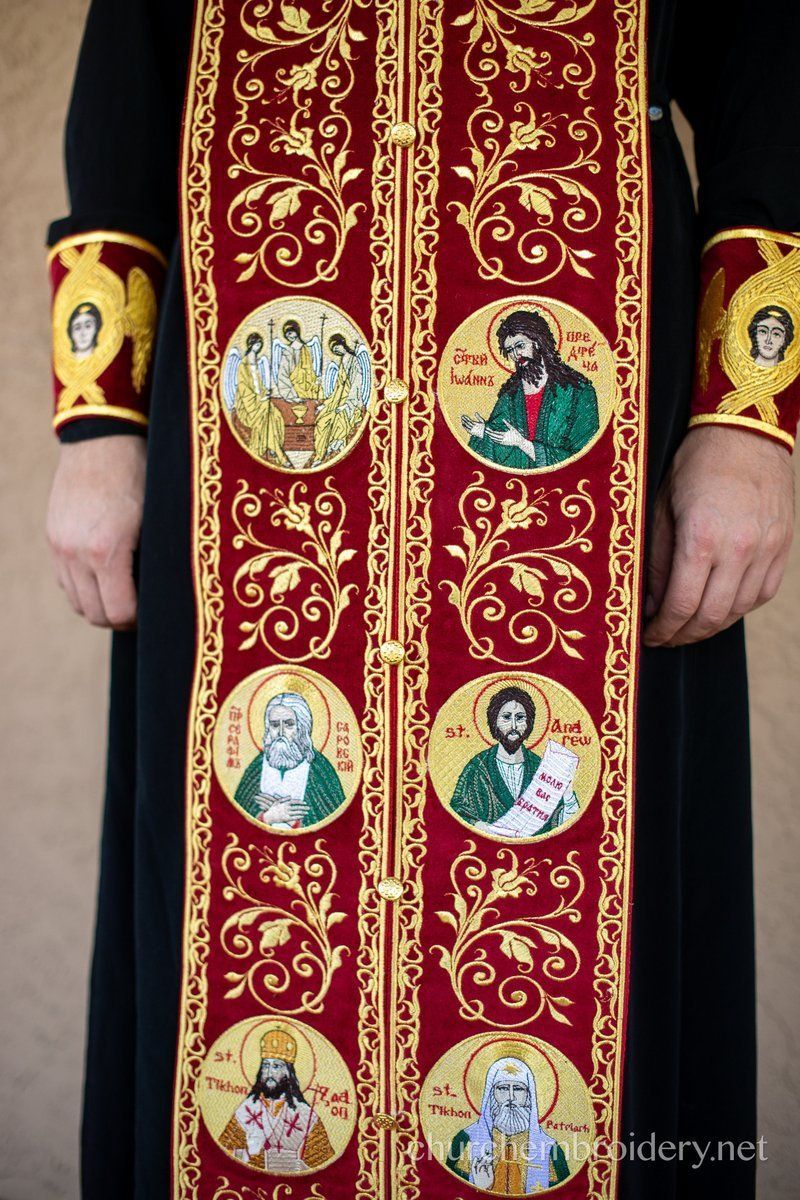
In Slavic traditions, red plays a much larger role. The Russian Orthodox Church uses red through almost all of Holy Week — Monday through Saturday before Pascha — because red expresses the blood of Christ's Passion. Red is also the colour of:
- The Sunday of the Myrrh-Bearing Women (third Sunday of Pascha)
- All feasts of martyrs
- The Apostles
- Some parishes also use red through the Pentecost season
The two practices express the same theology — that red is the colour of suffering love and the colour of blood — but Slavic practice extended its use to cover the dramatic centre of the year (Holy Week), while Greek practice reserved it more strictly for individual martyrs' commemorations.
Blue: Feasts of the Theotokos
Blue phelonions — usually a deep marian blue, sometimes a lighter sky blue — are worn on feasts of the Mother of God:
- The Nativity of the Theotokos (8/21 September)
- The Entrance of the Theotokos into the Temple (21 November / 4 December)
- The Annunciation (25 March / 7 April)
- The Dormition (15/28 August)
- All other Marian feasts and Sundays specifically commemorating her
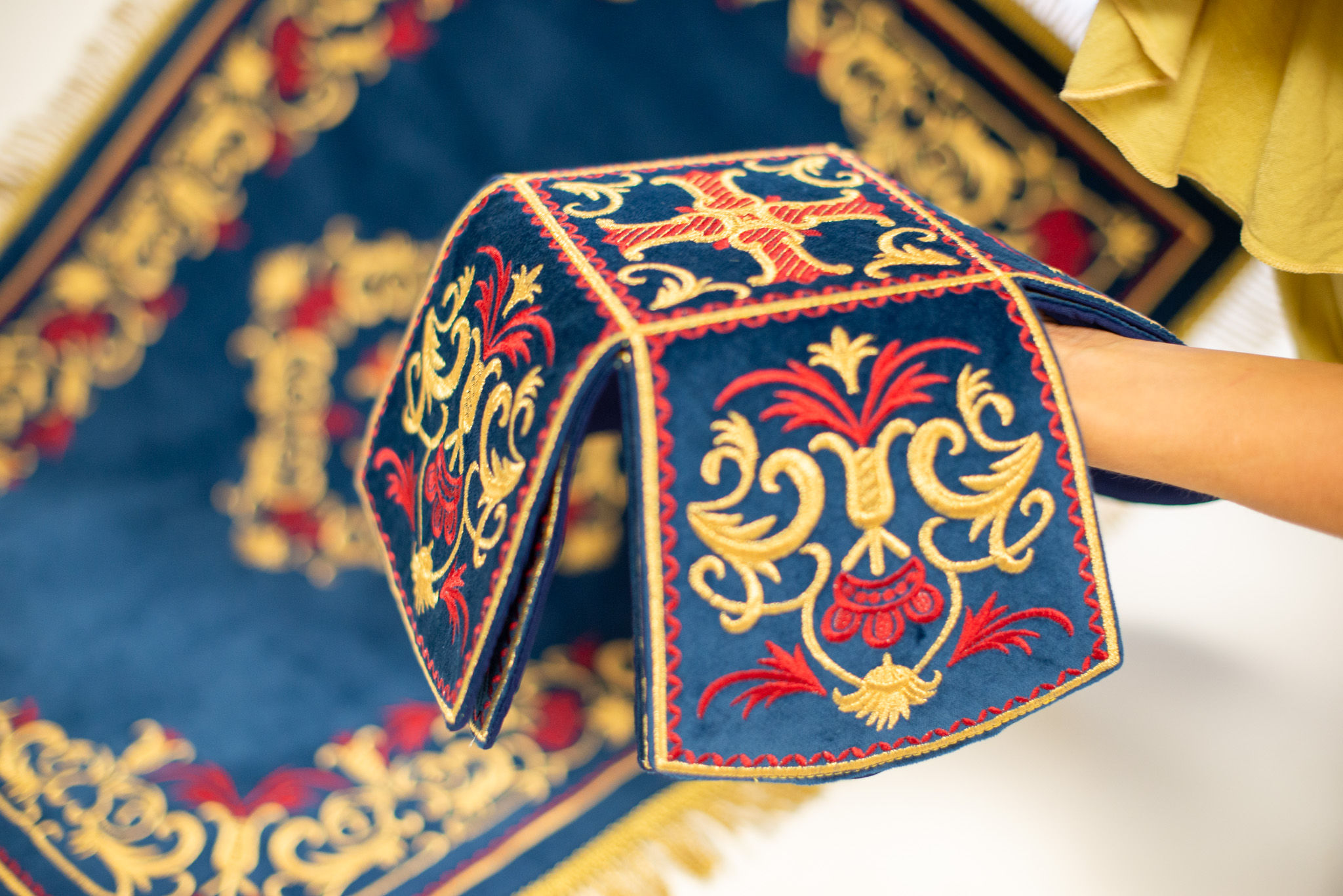
Blue is a relatively recent colour in Orthodox use. Until the seventeenth or eighteenth century, Marian feasts were celebrated in white or gold. Blue became the standard Marian colour first in Russian practice and then spread to other Orthodox jurisdictions; today it is universal.
Theologically, blue is the colour of heaven — the dome of the Virgin's protection, the mantle that wraps her in icons — and so the colour worn when her intercession is specifically being asked of the Lord.
Green: Pentecost, Palm Sunday, and the Monastic Saints
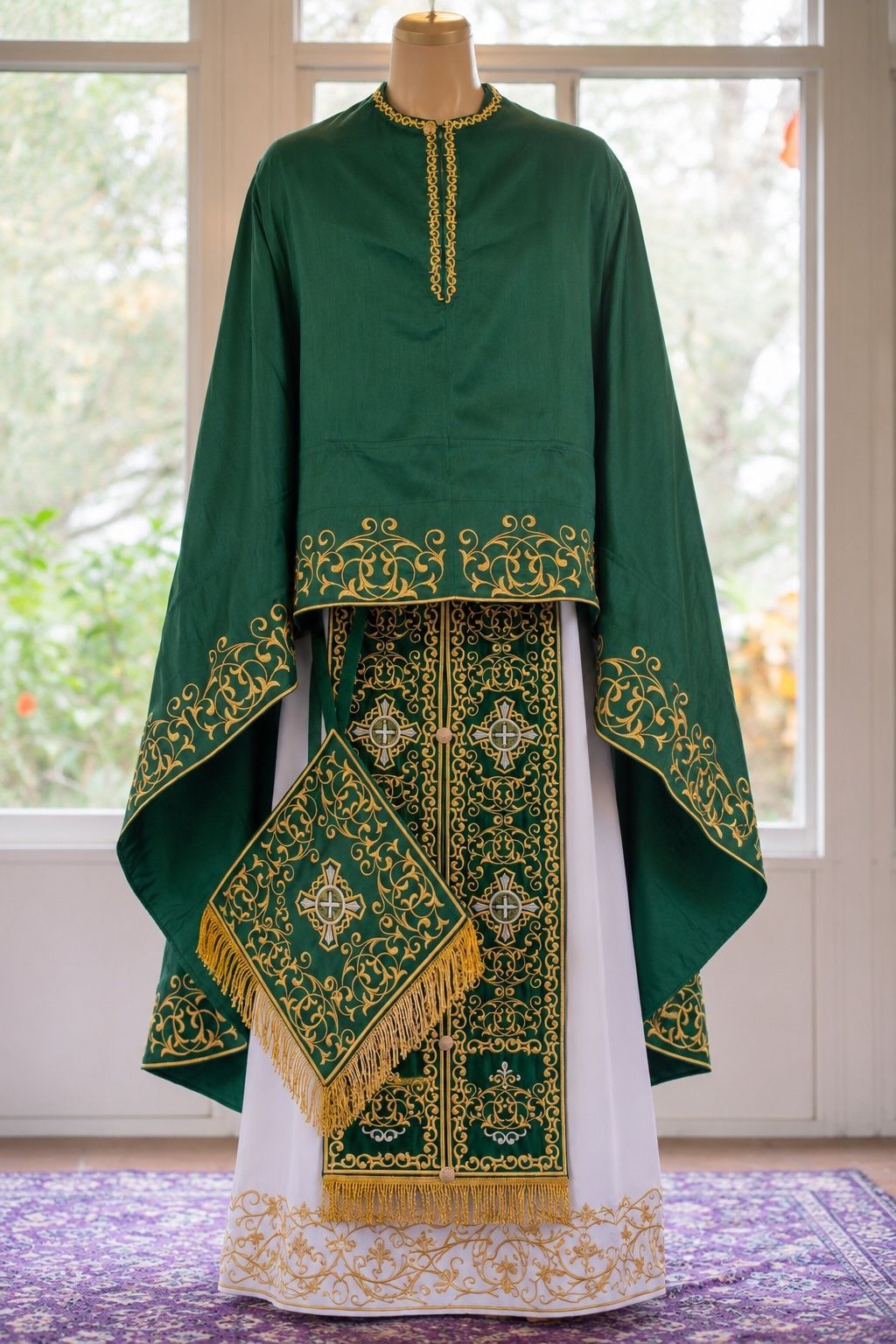
Green phelonions are worn on:
- Pentecost Sunday and Bright Monday (the Day of the Holy Spirit)
- Palm Sunday — when branches were strewn before Christ
- Feasts of monastic saints: Saint Anthony the Great, Saint Mary of Egypt, Saint Sergius of Radonezh, Saint Seraphim of Sarov, and the rest of the ascetic and monastic tradition
- Some feasts of the Cross (alternating with red and purple)
The theology of green ties together three things: the descent of the Holy Spirit on the "green branches" of Pentecost decoration, the palm branches of Palm Sunday, and the monastic life lived in the literal green of forests and wilderness. To see green at the altar is to see the colour of the Spirit who gives life — and of the saints who fled to the desert to live by Him.
Purple: Great Lent and the Cross
Purple — sometimes deep violet, sometimes a dark wine red — is the colour of penitence and royal sorrow. It is worn on:
- The Sundays of Great Lent — six Sundays from Forgiveness Sunday through Lazarus Saturday
- Feasts of the Cross: the Universal Exaltation (14/27 September), the Sunday of the Cross in Lent, the Procession of the Cross (1/14 August)
- In Greek practice, purple covers both Sundays and weekdays of Lent
The theological echo is from the Passion: when the soldiers mocked Christ before His crucifixion they put on Him a purple robe, intending to ridicule His claim to kingship. The Church accepts the mockery as truth — Christ is the King who reigns through His Passion — and wears purple in Lent to repent of having joined that mockery, while also acknowledging that He is the King.
Black: Lenten Weekdays and Mourning
Black is the most penitential colour. It is worn on:
- Weekdays of Great Lent in Slavic practice (purple is reserved for Sundays)
- Holy and Great Friday in many traditions
- Funerals in Slavic practice (white in Greek practice)
- Certain memorial services for the departed
Black is unique in being the only purely mourning colour the Church uses. It is also a relatively late liturgical colour — Russian practice before the seventeenth century used purple for all of Lent — but black has been universally adopted in Slavic parishes since then.
A Year of Phelonions
Watch one priest across one year and you'll see his phelonions rotate like a slow calendar. Gold from autumn through the start of Advent. White at Christmas. Gold again in January with a blue interlude for the Meeting of the Lord. Purple or black for Great Lent. Red (Slavic) or purple (Greek) for Holy Week. White for Pascha and Bright Week. Gold again from the second Sunday of Pascha onward, with green for Pentecost. Gold through the summer with blue for the Dormition and white for the Transfiguration. The cycle repeats.
Each transition tells a small story. The priest in white at Pascha midnight is wearing the same colour the angels wore at the empty tomb. The priest in purple on the Sunday of the Cross is wearing what the soldiers put on Christ. The priest in red at the feast of a martyr is wearing the colour of that martyr's blood. None of this is announced; the cloth speaks for itself.
Ordering Phelonions in Every Colour
A complete set of phelonions spanning the seven liturgical colours is the work of years. Most parishes acquire them one at a time, in the order most useful to their cycle. Our priest vestments category lists phelonions across all the standard colours, and we make to order in any specific shade your parish needs. For a full year-by-year plan, see our guide on how to choose vestments for your parish.