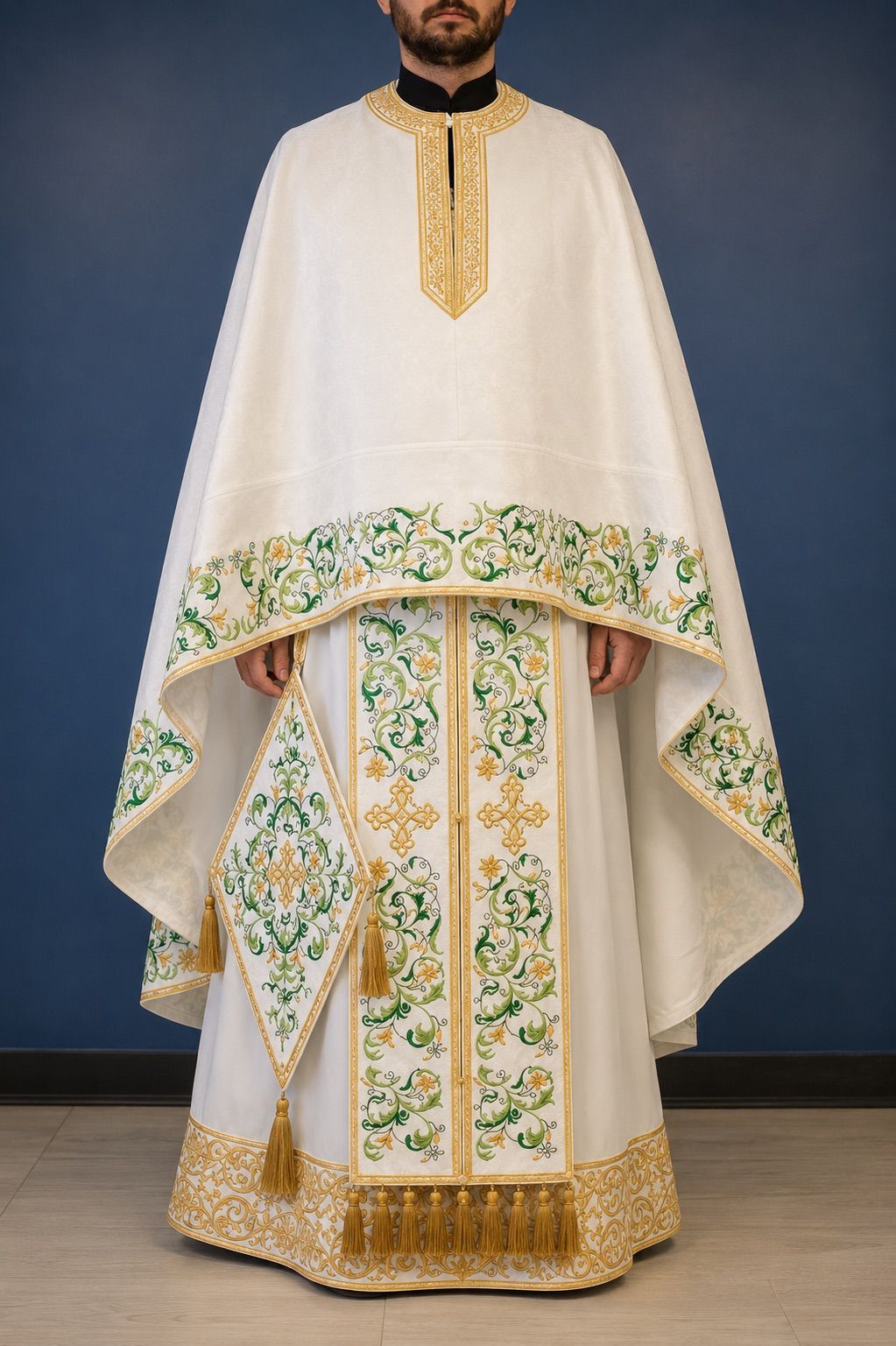
Outfitting an Orthodox parish with vestments is a project that runs for years, sometimes decades. Few parishes start with a complete set of seven liturgical colours, matching altar covers, banners, and chalice covers. Most begin with a single gold set, a worn-out hand-me-down altar cover, and a long list of "someday." This article is for the rector, the warden, or the parish council member trying to figure out where on that list to start.
By the end you'll have a working plan: what to buy first, what to add next, how to think about colours, how to handle the Greek-versus-Slavic question, and how to spread the cost across several years without ever leaving the parish unable to serve a feast.
Where to Start: The First Set
If a parish can afford only one thing this year, it should be a complete gold vestment set for the priest. The reason is simple arithmetic: gold covers the largest portion of the liturgical year. Of the roughly fifty-two Sundays in a year, somewhere between thirty and forty are served in gold. Of the twelve great feasts, several are gold (or have gold as an acceptable colour). For a parish with a single working set, gold is the colour that maximises usable Sundays.
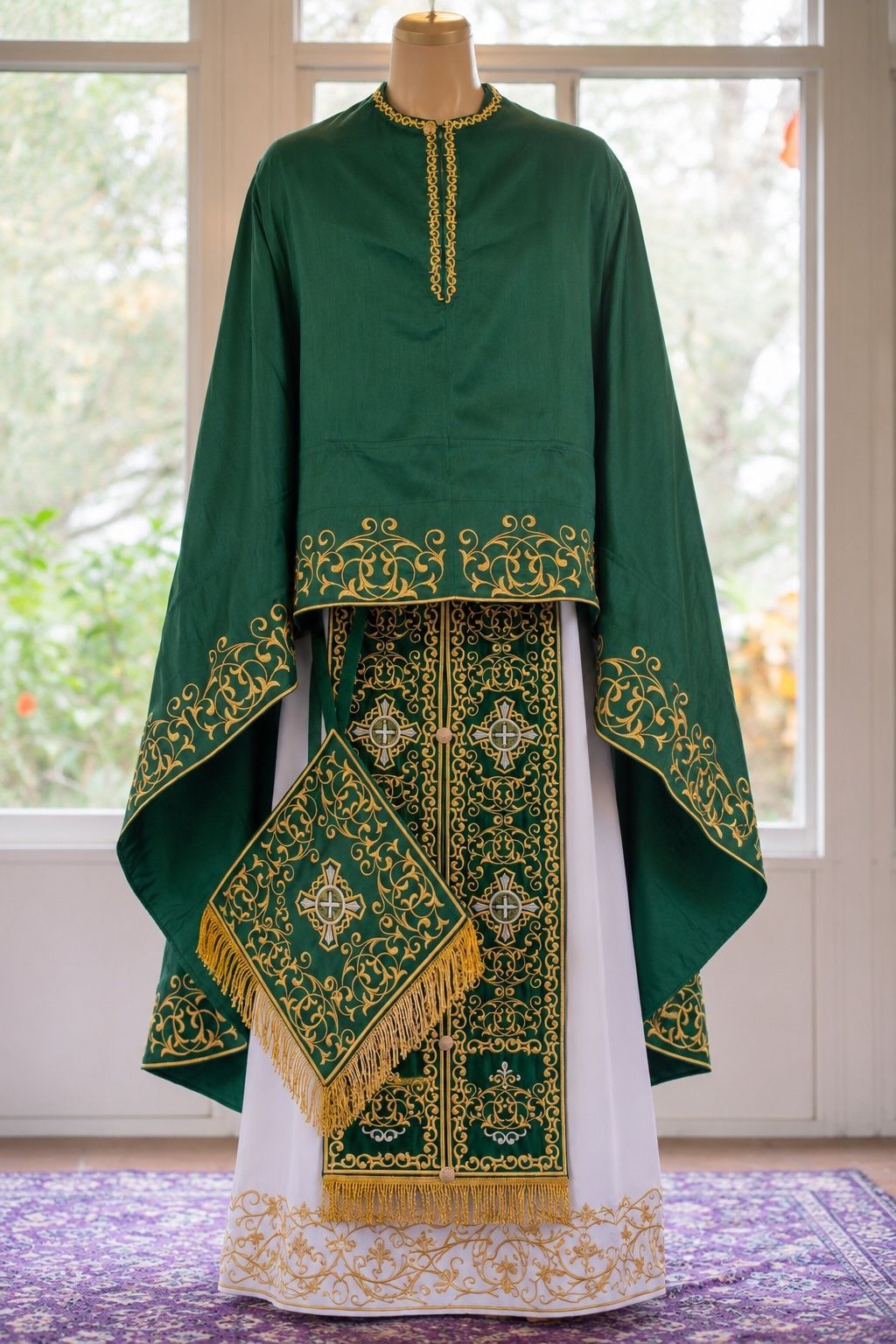
A complete gold set should include:
- Phelonion (the outer chasuble)
- Sticharion (the long inner robe)
- Epitrachelion (the stole)
- Zone (the belt)
- A pair of poruchi (cuffs)
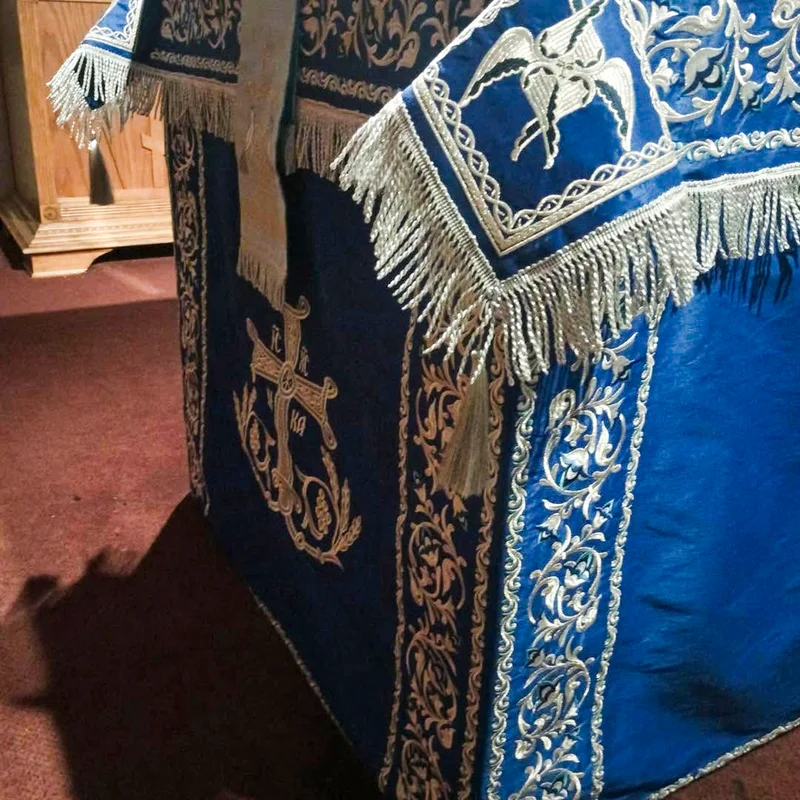
Plus, ideally, a matching gold altar cover and a gold cover set for the chalice and diskos. Ordered together with the priest set, in the same brocade, these textiles cost significantly less per piece than ordering them as separate commissions later — and they look right, because the altar reads as one composition rather than four mismatched layers. See our priest vestments, altar covers, and chalice covers categories.
The Order of Acquisition
After the gold workhorse set, what comes next? In our experience, the most useful order of acquisition for a small parish is:
- Gold set — phelonion, sticharion, epitrachelion, zone, cuffs; matching altar cover; matching chalice covers. This is the foundation.
- Purple or dark-red set — for Great Lent and Holy Week. Most parishes find they need this within the first liturgical year, because Lent occupies six full weeks plus Holy Week. If your parish follows Greek practice, purple covers all of Lent; if Slavic, you might want both purple (for Sundays) and black (for weekday services). Start with purple.
- White set — for Pascha and the bright feasts. Pascha is the most important day of the year. Serving it in a tired gold set when a white set was within reach is something every priest regrets. By year three or four most parishes have ordered white.
- Red set — for martyrs and (in Slavic practice) Holy Week. After white, red is the next most-used.
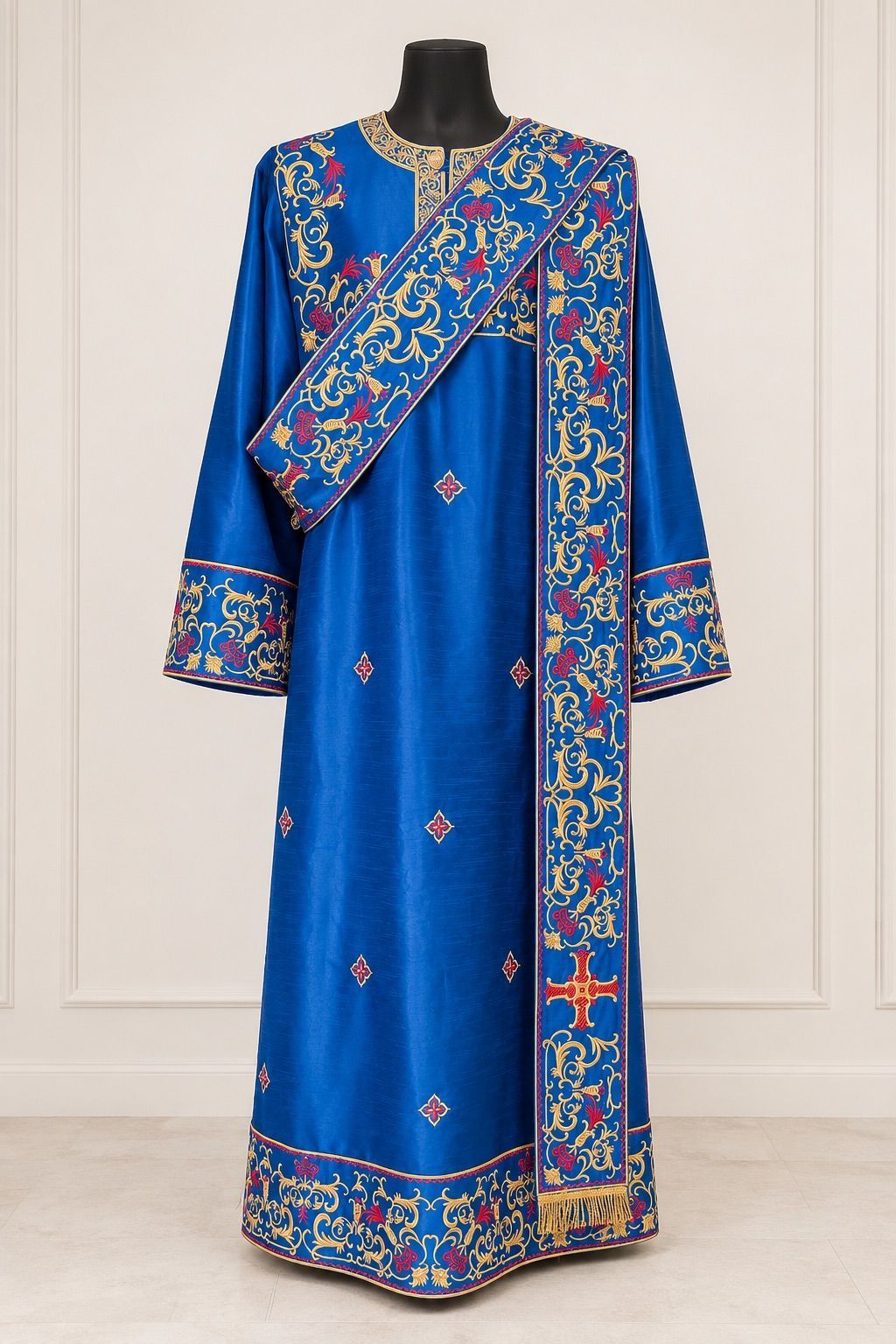
- Blue set — for feasts of the Theotokos. There are roughly six major Marian feasts in the year plus smaller commemorations. A parish dedicated to the Mother of God should accelerate blue to second or third position; others can wait.
- Green set — for Pentecost and the monastic saints. Lowest in use frequency but very visible when it appears.
- Black set — only really needed for funerals (in Slavic practice) and Holy Friday. Many parishes never order a full set and use the purple or a borrowed set for these.
For more on each colour and when it's worn, see our reference article on liturgical colours and when they're used.
Greek-Cut or Slavic-Cut: Which Does Your Parish Need?
One decision needs to be made before the first commission goes out: what tradition does your parish follow? The phelonion is cut differently in Greek and Slavic traditions, and the deacon's orarion is worn differently. A vestment set in the wrong cut for your parish will look out of place at every concelebration with other clergy of your jurisdiction.
A short guide:
- OCA, ROCOR, Moscow Patriarchate, Ukrainian Orthodox, Serbian Orthodox, Bulgarian Orthodox: Slavic / Russian cut.
- Greek Orthodox Archdiocese, Antiochian Orthodox, Romanian Orthodox, Greek monastic communities: Greek cut.
The Antiochian Archdiocese in North America is mixed in practice — many parishes use vestments closer to the Russian cut despite following Greek liturgical practice. When in doubt, ask the bishop's office, or send us a photograph of vestments your parish already owns and we'll match the cut.
For a deeper look at the differences, see our article on Greek vs Russian Orthodox vestments.
Coordinating Across Textiles
Parishes who order each piece separately — vestments from one workshop, altar cover from another, chalice covers from a third — almost always end up with a sanctuary that doesn't quite match. Three slightly different shades of gold. Three different embroidery styles. A visible mismatch that the eye reads even when no one can articulate it.
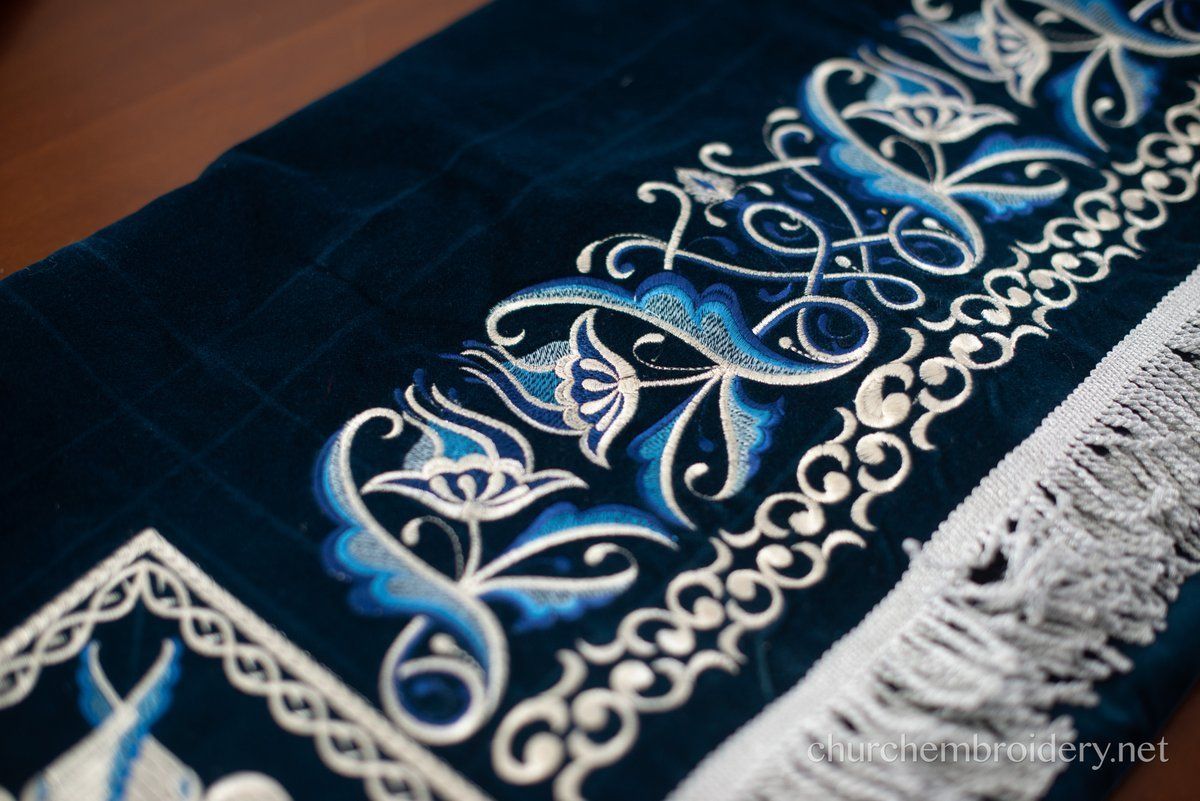
The fix is to order coordinated sets — vestments, altar cover, analogion covers, chalice covers, and a banner of the patronal feast — in the same brocade. The brocade is the unifying element. Embroidery can vary (a phelonion's icon panel doesn't need to repeat on an altar cover), but if the underlying cloth is the same, the sanctuary reads as one composition.
Practical tip: when you commission your gold set, ask the workshop to reserve enough of that exact brocade for a future altar cover and chalice covers. We routinely set aside ten to twenty extra metres of brocade for parishes that plan to expand a set over years.
Lead Times and Annual Planning
Hand-embroidered vestments take 6–12 weeks to produce. Add another two weeks for shipping if you're outside the US. That means orders should be placed:
- For Pascha: by January at the latest. February if you're commissioning a simple set; January if it's hand-embroidered with icon panels.
- For Great Lent: by late autumn — November or early December.
- For the patronal feast: at least three months ahead.
- For an ordination: at least three months ahead, four or five if you can. See our guide to ordination commissions.
Most parishes operate on a rolling annual plan: every January, the parish council decides what one or two textiles to commission for that year. Place orders in late winter or early spring, receive the pieces over the summer and autumn, dedicate them on the appropriate feast.
Budgeting Across Years
A realistic budget guide for a complete parish vestment programme, spread over five years:
| Year | Acquisitions | Approx. cost |
|---|---|---|
| 1 | Gold priest set + matching altar cover + chalice covers | $1,500–2,500 |
| 2 | Purple set (vestments + altar cover) for Great Lent | $1,000–1,800 |
| 3 | White set for Pascha (vestments only first; altar cover next year) | $800–1,400 |
| 4 | Red set + white altar cover + parish banner | $1,400–2,200 |
| 5 | Blue set (or other remaining colour); analogion covers; bookmark set for the Gospel | $1,200–2,000 |
Total over five years: roughly $6,000–10,000 for a parish to be fully outfitted across five liturgical colours. Spread across sixty months, that's about $100–170 per month — a single Sunday's collection in most parishes.
If money is tight, parishes can do this on a much slower schedule — one colour every two years instead of every year — and still arrive at a complete set within a decade. There is no rush. Vestments outlast the people who order them.
One Last Principle
It's tempting, when you have limited money, to economise by ordering machine-embroidered vestments and treating the embroidery as decoration. We understand the impulse and we make machine-embroidered pieces too. But a parish's vestments are not just clothing for the priest — they are catechesis for the congregation, week after week, decade after decade. A simpler set that is well-made and properly hand-embroidered teaches more than an elaborate machine-stitched one. If you have to choose between "more pieces" and "better made," err toward better made. Browse our full priest vestments and altar covers collections to compare, or contact us for a quote on a coordinated parish commission.