An Orthodox Christian who attends a Greek parish for years and then steps into a Russian one will know immediately that something is different — even before the language changes. The icons sit at different heights on the iconostasis. The chant runs in a different mode. And the vestments, though they cover the same priests serving the same Liturgy, have a noticeably different silhouette.
The differences aren't theological. They are aesthetic and historical — the result of two daughter traditions developing in parallel for a thousand years, in Byzantium and in Kievan Rus' and the Russian empire. This article walks through the practical differences in Greek vs Russian Orthodox vestments: what each tradition does, where they diverge, and what to specify when you order.
Why There Are Two Traditions
Both Greek and Russian liturgical vestments inherit from the Byzantine Empire of the high middle ages — the seventh through the fourteenth centuries — when the Liturgy and its vestments were standardised across the Christian East. After the fall of Constantinople in 1453, the Greek tradition continued under Ottoman rule, while the Russian tradition developed under independent grand princes and then tsars. The two traditions remained in full communion and shared the same Liturgy, but their craftsmanship and aesthetics moved in different directions.
The most visible split came in the seventeenth and eighteenth centuries. In Russia, Patriarch Nikon's reforms (1652–1666) self-consciously adjusted Russian practice toward the contemporary Greek model — but Russian vestments themselves continued to develop a distinctive style, eventually drawing in Baroque and Rococo influences from Western Europe under Peter the Great and Catherine. By 1800, Russian liturgical embroidery looked quite different from Greek, even though the underlying vestments were the same.
The Phelonion: The Main Visible Difference
The single most diagnostic difference between Greek and Russian vestments is the phelonion — the outer chasuble worn by the priest at the Divine Liturgy.
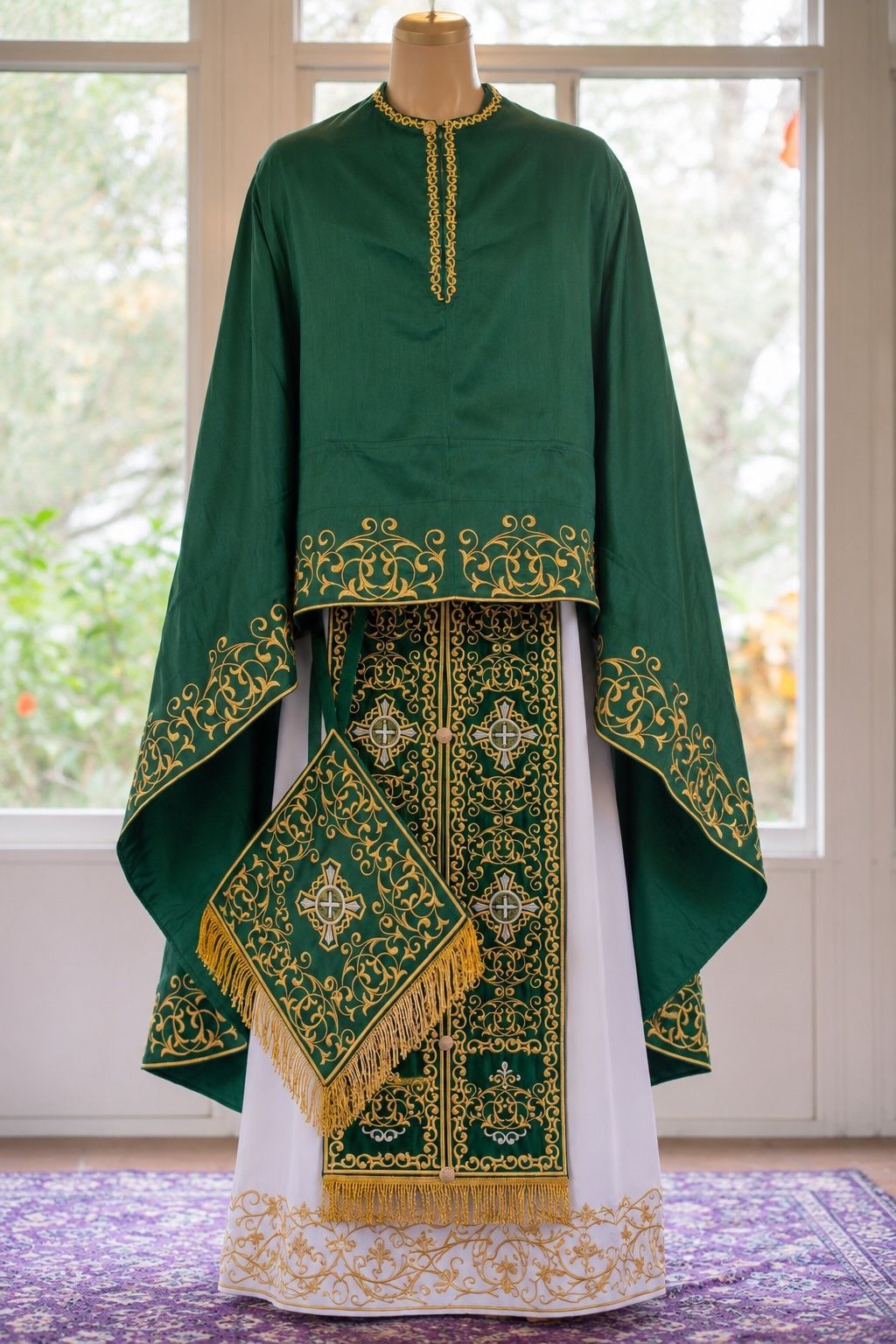
The Greek-cut phelonion
- Shape: fuller and more rounded, falling to mid-calf or just above the ankles.
- Neckline: wide, soft, often without any collar at all. The shoulders are exposed to view, showing the embroidered cuffs and the epitrachelion underneath.
- Front: cut higher in front than the back, sometimes cut quite short in front for ease of movement.
- Look: closer to the Byzantine icon-tradition silhouette. Watch any Athonite monk celebrate Divine Liturgy and you'll see the classic shape.
The Russian-cut phelonion
- Shape: narrower overall, with the chasuble pulled inward at the sides.
- Neckline: the most distinctive feature — a tall, stiffened back collar that rises above the priest's head. The collar is reinforced with interlining and stays vertical.
- Front: cut shorter in front than the back, sometimes dramatically so, with the back falling lower.
- Look: the silhouette familiar from Russian, Ukrainian, Belarusian, and most Serbian parishes. The high collar is the giveaway.
Both shapes are correct. Both are made and worn today. When you commission a phelonion, please specify which cut — see our priest vestments category for both styles, or send us a photo of vestments your parish already uses.
Embroidery: Different Visual Languages
Both traditions use the same techniques — couched goldwork, metallic-thread embroidery, applied trim — but the visual language differs in important ways.
Greek embroidery
Tends toward:
- Byzantine iconographic style — figures with elongated proportions, large eyes, the formal stillness familiar from Byzantine icons.
- Geometric and floral patterns on the body of the phelonion, often inspired by Byzantine textiles.
- A relatively restrained colour palette — gold on coloured brocade, with limited use of secondary embroidery colours.
- Icon panels on the back of the phelonion, often a cross of saints or the Resurrection.
Russian embroidery
Tends toward:
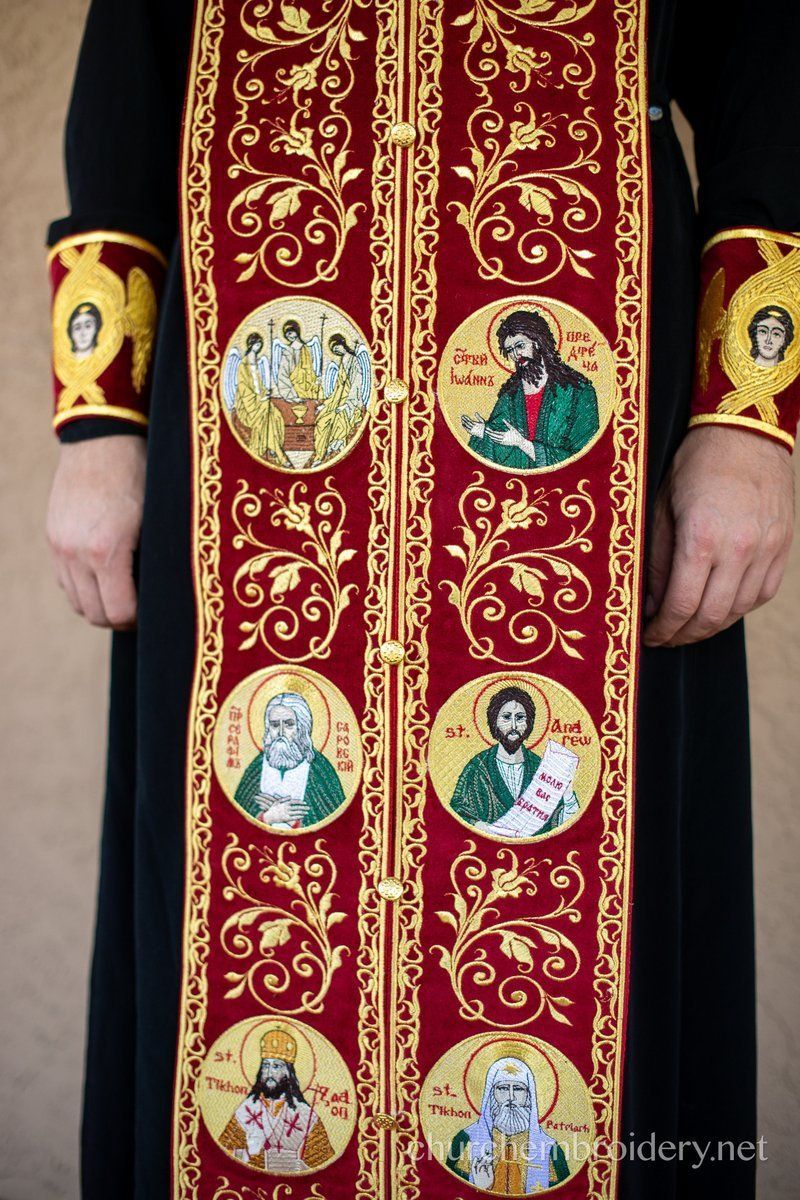
- Naturalistic floral motifs — roses, leaves, branches in silk and gold, woven into the brocade and embroidered on top.
- Heavier use of pearls, sequins, and faceted glass stones, especially on episcopal vestments and the most elaborate priest sets.
- Iconography in the Russian Synodal style — softer, more naturalistic faces drawn from Western influences after Peter the Great.
- The cross or icon on the back of the phelonion is often surrounded by elaborate scrollwork.
A skilled embroiderer can work in either style; the choice depends on the parish's tradition. Many monastic communities, both Greek and Russian, deliberately revive earlier Byzantine styles, considering the more naturalistic forms of the eighteenth and nineteenth centuries to be a Western intrusion.
The Cassock and Collar
Outside the Divine Liturgy, when the priest is going about parish business, you can still tell the tradition by his everyday clothing.
- Greek priests wear a rason (outer robe) with wide sleeves over an inner cassock. The outer rason is open in front like a coat. The hat is the tall cylindrical kalimavkion, often with a veil hanging behind (for monks and married priests above the rank of presbyter).
- Russian priests wear a podriasnik (inner cassock, fitted) and ryassa (outer cassock, looser). The ryassa is closed in front with a row of buttons or hooks. The hat is the round-topped skufia (everyday) or the cylindrical kamilavka (more formal).
The Russian married priest also typically wears a pectoral cross over the outer cassock at all times — a practice less universal in Greek parishes, where the pectoral cross is more commonly worn under the outer cassock and only displayed when liturgical vestments are being worn.
The Orarion: Crossed or Hanging?
The deacon's orarion — the long stole over his left shoulder — is the same length and material in both traditions, but it is worn differently.
- Greek practice: the orarion hangs straight down, front and back, from the left shoulder. Both ends fall freely.
- Slavic / Russian practice: the orarion is brought across the body — looped under the right arm and the front end is tucked into the belt or held in the right hand, so the band crosses the chest diagonally.
Both are correct. A protodeacon or archdeacon in either tradition wears a longer "double orarion" that wraps multiple times around the body. See our orarions category for both styles.
The Sticharion
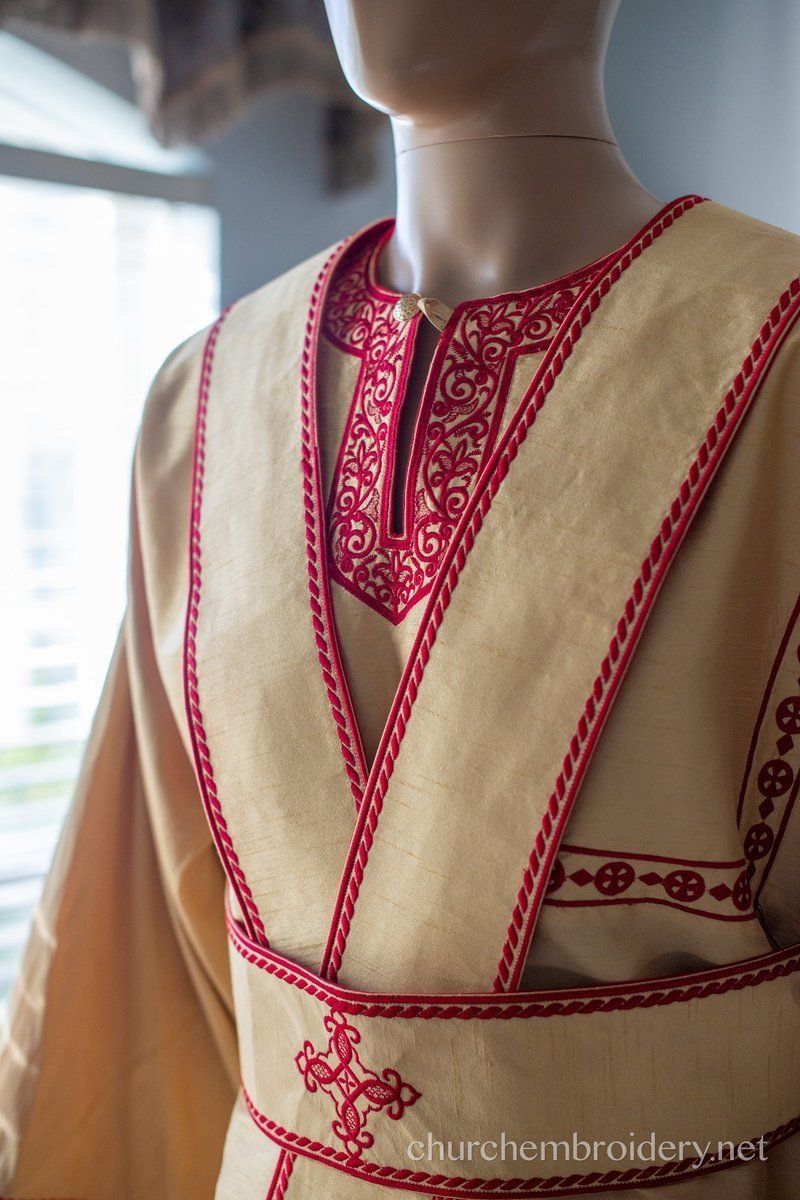
The basic sticharion is identical in both traditions — a long ankle-length robe with full sleeves and a slit at the neck. Two subtle differences:
- Greek sticharions are often plainer in the body and richly embroidered only at the cuffs, hem, and chest. Russian sticharions can carry more elaborate trim down the front panel and along the sleeve openings.
- For deacons, both traditions use full-length sticharions richly trimmed, but Russian deacon sticharions tend toward heavier overall embroidery, with the front panel often decorated with full icons of the Mother of God or the patron of the parish.
Bishop's Vestments
At the episcopal level the differences become more visible:
- Mitre: Greek mitres are round, crown-shaped, decorated with icons set into the crown. Russian mitres are taller, with a single large cross at the top and four icons of evangelists around the band. The Russian mitre rises into something close to a domed crown; the Greek mitre stays closer to a circlet.
- Mantya: the bishop's processional mantle is purple in Russian tradition and dark blue or red in Greek tradition, with embroidered "fountains" of the Old and New Testaments and bells at the hem.
- Eagle rugs (orletsy): small embroidered rugs with the icon of an eagle, placed under the bishop's feet at significant moments. These are universal in Russian practice and less common in Greek parishes.
Which Tradition Should We Order?
If you're outfitting a parish, you should order in the tradition the parish follows — not because the other is wrong, but because the priest will be serving with other clergy of his jurisdiction at concelebrations, and his vestments should match.
A short guide:
- OCA, ROCOR, Moscow Patriarchate, Ukrainian Orthodox Church, Serbian Orthodox Church, Bulgarian Orthodox Church: Slavic / Russian cut by default.
- Greek Orthodox Archdiocese (Ecumenical Patriarchate), Antiochian Orthodox, Romanian Orthodox in the US, Greek monastic communities: Greek cut by default.
The Antiochian Archdiocese in North America is an interesting in-between case: it follows Greek liturgical practice but many of its priests wear vestments closer to the Russian cut, reflecting both the diversity of the Antiochian patriarchate and the local custom of converts coming from various backgrounds.
When in doubt, ask your bishop or your senior priest. Vestments can also be made in either cut by request — the same embroiderer can produce Greek-style for one parish and Russian-style for another, in the same brocade.
Both Sides of the Same Tradition
It's worth ending where we started: the differences between Greek and Russian Orthodox vestments are real but they are entirely aesthetic. The same Liturgy is celebrated in both. The same scriptures are read. The same colours mark the seasons (with the small variations we covered in our article on liturgical colours). A Greek priest visiting a Russian parish vests in Russian vestments without difficulty; a Russian priest visiting a Greek parish does the same.
The two traditions are like two members of the same family who dress differently but share the same name. To know one well is to know the other; to know both is to see how rich the unity of the Orthodox Church actually is.
To order vestments in either tradition, browse our priest vestments and deacon vestments. Tell us which cut you serve in and we'll make accordingly.