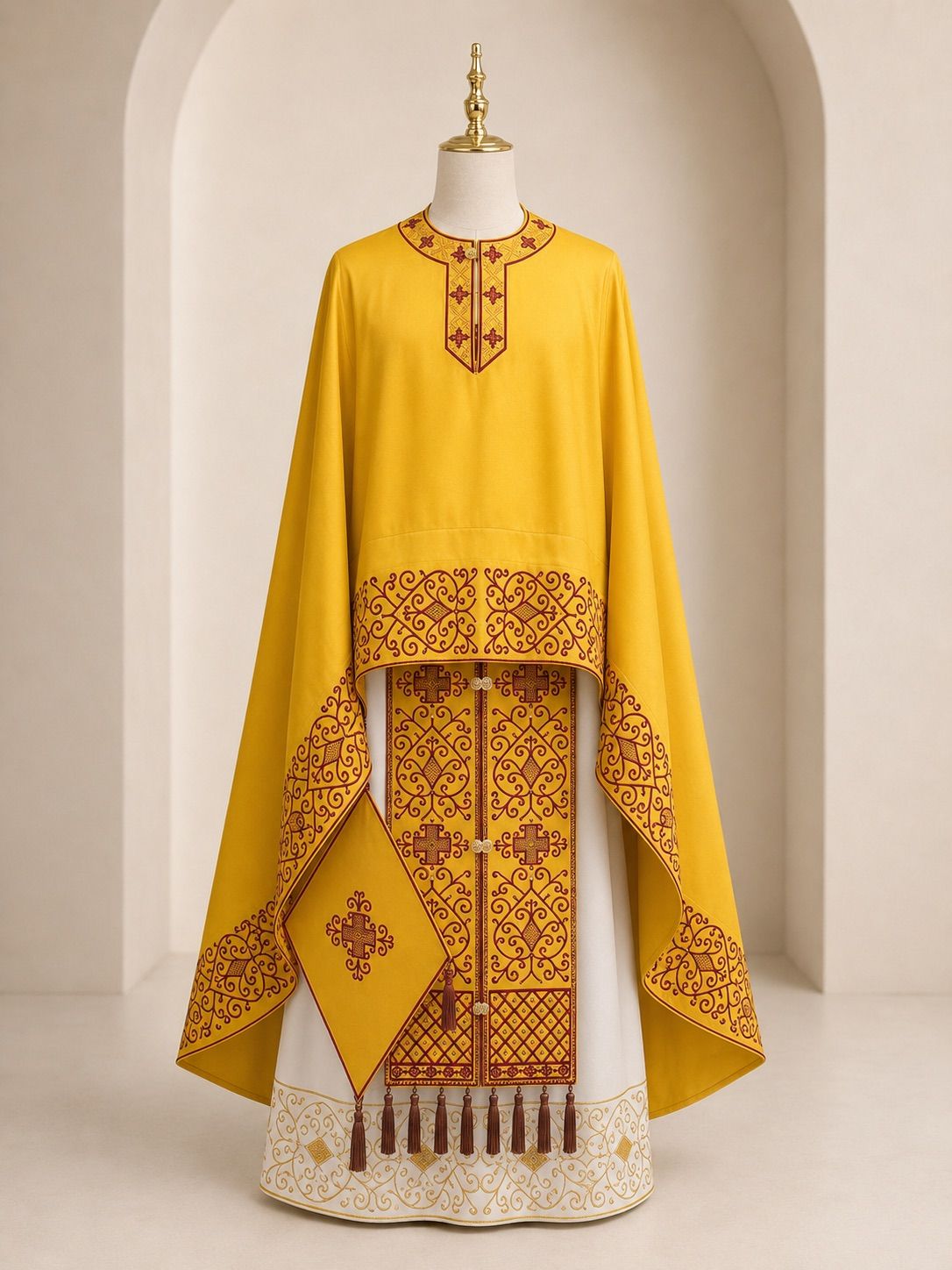
If you've spent any time in an Orthodox church you've probably noticed: the clergy don't all dress alike. A deacon stands at the doors of the iconostasis in a long, flowing robe with a single embroidered band over his shoulder. A priest stands at the altar in a heavier, gathered chasuble. A bishop, on the days he visits, wears yet another shape — squarer, shorter, with bells on the hem.
The three are called, respectively, sticharion, phelonion, and sakkos. Each is the principal outer vestment of one of the three major orders of Orthodox clergy. They look related because they are: all three descend from late Roman daily clothing. But the differences between them — in cut, in symbolism, in who wears what — say something specific about the hierarchy of the Church.
This article compares the three side by side. By the end you'll be able to walk into any Orthodox service, look at the front of the church, and read the ranks from the cloth alone.
The Three at a Glance
| Vestment | Worn by | Shape | Roman ancestor |
|---|---|---|---|
| Sticharion | All clergy (deacon as outer; priest/bishop as inner) | Long ankle-length robe with wide sleeves | Roman tunic |
| Phelonion | Priests (and as Liturgy inner-wear for bishops in some traditions) | Round/oval chasuble open in front, longer at back | Roman paenula (travelling cloak) |
| Sakkos | Bishops | Square knee-length tunic with short sleeves; open sides with buttons/bells | Byzantine imperial dalmatic |
1. The Sticharion: The Universal Inner Vestment
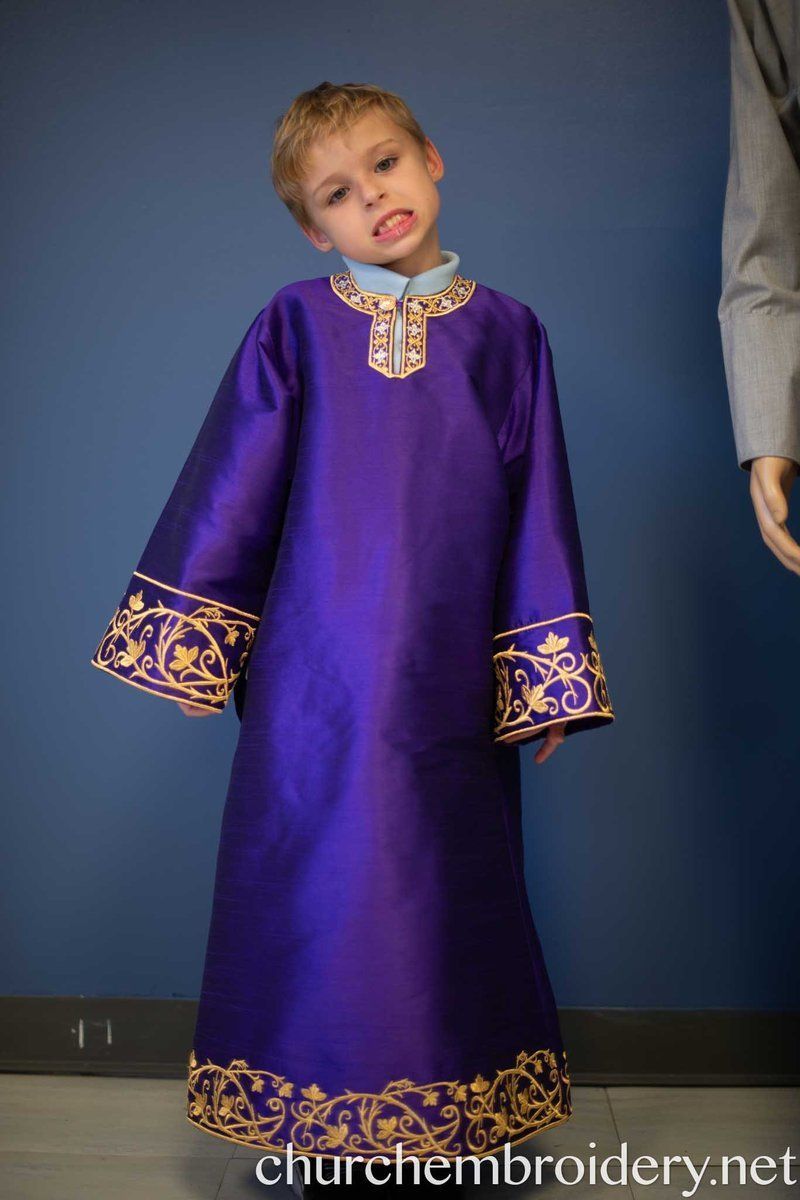
The sticharion is the most ancient of the three. In its form — a long tunic, ankle-length, with wide sleeves and a slit at the neck — it is essentially unchanged from the daily tunic worn across the Roman world in the second and third centuries.
Every order of Orthodox clergy wears a sticharion. Where they differ is whether it shows.
- For a deacon: the sticharion is the principal outer vestment. It is what you see when he stands at the doors of the iconostasis. Deacon sticharions are usually more visibly embroidered — with a cross on the chest, decorative trim along the sleeves, and the colour of the season — because they're meant to be looked at.
- For a priest: the sticharion is the inner layer, mostly hidden by the phelonion. Priest sticharions are usually plainer; only the cuffs and the hem at the foot are visible during the service.
- For a bishop: the sticharion is the inner layer beneath the sakkos. It is treated like a priest's sticharion: present but not the visible centre of the vestments.
Whatever its position in the layering, the sticharion is always white at baptism and ordination, and may be the colour of the liturgical season thereafter. It is the garment of salvation — the priestly equivalent of every Christian's baptismal robe. Browse our sticharion category for current pieces.
2. The Phelonion: The Priest's Chasuble
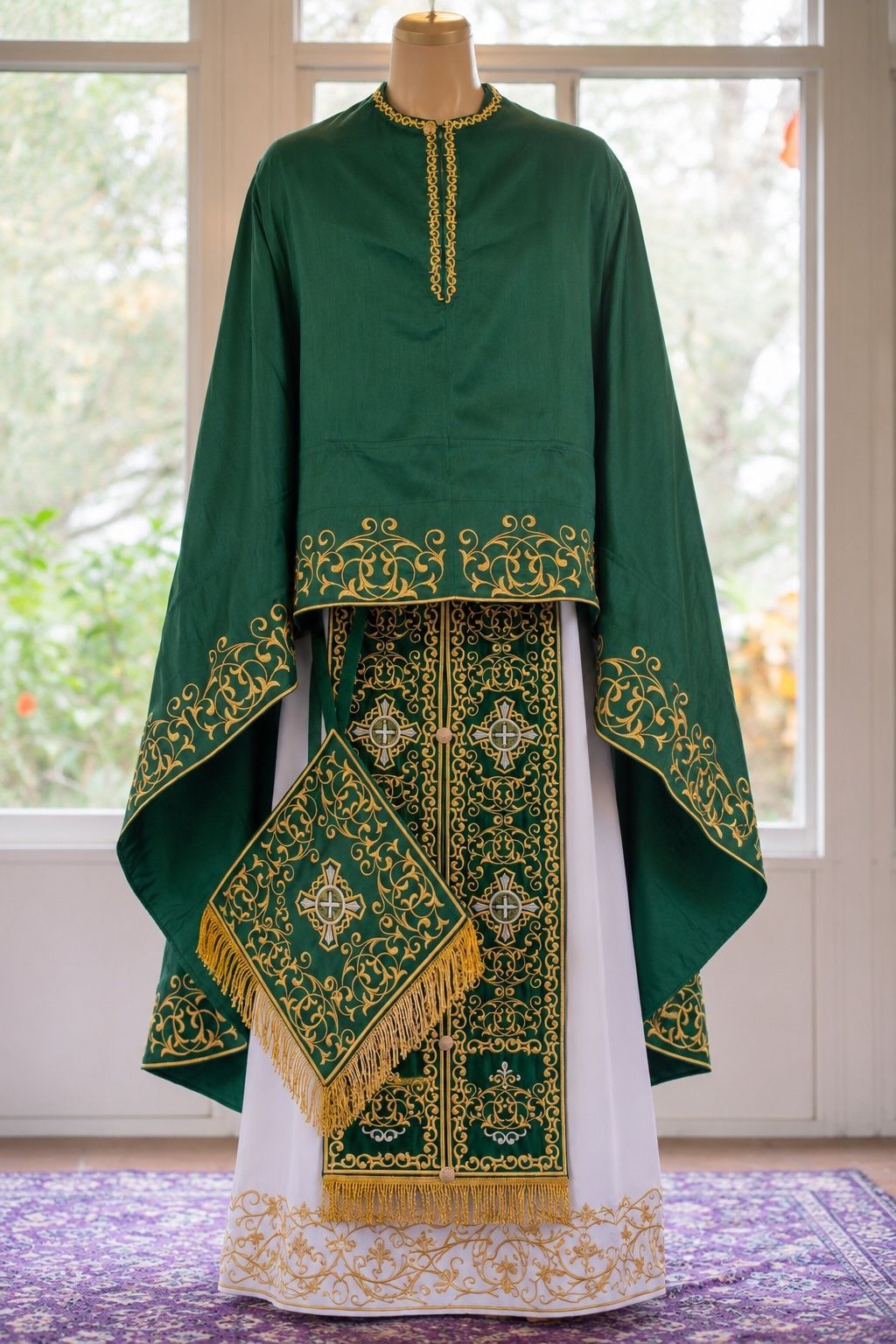
The phelonion (Greek: phailónion) is the outer vestment of a priest. In shape it is a large, roughly circular piece of brocade with an opening in the centre for the head — falling longer behind than in front so the priest's hands stay free. Its ancestor is the Roman paenula, the heavy travelling cloak worn by ordinary citizens in cold weather: a hooded shape that pulled over the head and draped to the calves.
What distinguishes a phelonion from anything else is what it covers. It is worn over the sticharion, the epitrachelion (stole), the zone (belt), and the cuffs. It is the outermost layer; everything else is hidden under it. When a priest is fully vested, the phelonion is what defines his silhouette.
Two main shapes survive today:
- Greek-cut phelonion: the older, more traditional form — fuller, more rounded, falling to mid-calf with a wide soft neckline. The shape you'd see in Byzantine icons of the great hierarchs.
- Russian-cut phelonion: developed in the late seventeenth and eighteenth centuries — narrower, with a tall, stiffened back like a high collar. The silhouette familiar from Russian, Ukrainian, and Serbian parishes.
The choice of cut follows the tradition the parish serves. Both are correct; both are made and worn today. See our priest vestments category for examples in both styles.
3. The Sakkos: The Bishop's Tunic
The sakkos is the third great Orthodox vestment, and the visual marker of the episcopate. Where the phelonion is a chasuble (a cloak), the sakkos is a tunic — square cut, knee-length, with short sleeves that end well above the wrists, and open along the sides where small buttons or bells fasten it loosely.
Its origin is not, like the phelonion, in ordinary Roman dress. The sakkos was originally a Byzantine imperial garment — the dalmatic — worn by the emperor as a sign of mourning or humility (the word "sakkos" comes from sackcloth). In the eleventh and twelfth centuries the emperors began granting it as an honour to particularly distinguished bishops; gradually, by the fifteenth century, it became the standard outer vestment of all Orthodox bishops, replacing the phelonion that earlier hierarchs had worn.
The sakkos is shorter than a phelonion, with short sleeves that show the embroidered cuffs of the sticharion beneath. It is always richly embroidered, often with icons on the front and back. Bells (kodoni) hung along the edges in older sakkoi recalled the Old Testament high priest's robe in Exodus 28; many modern sakkoi still have small decorative bells, though they may be silent.
The sakkos is worn together with several specifically episcopal vestments — the omophorion (stole-like band over the shoulders), the mitre (jewelled crown), the panagia (icon medallion), and the engolpion. We cover those in a separate article on bishop's vestments.
How to Tell Them Apart Across a Crowded Church
Three quick visual cues:
- Where the embroidery is. A deacon's sticharion shows embroidered trim all down the front and sleeves — because the sticharion is his outer vestment. A priest's phelonion is heavily embroidered on the back and shoulders, with a cross or icon panel at the centre back; the front is plain because most of it is folded forward. A bishop's sakkos has rich embroidery on front and back, often with full icon panels on both.
- Where the sleeves end. Deacons and priests have full-length sleeves on their outer garment (sticharion or phelonion). Bishops have short sleeves on their sakkos, showing the embroidered poruchi (cuffs) at the wrists. The visible cuffs are diagnostic: if you see embroidered wrist bands, you're looking at a bishop in a sakkos.
- What hangs around the neck. A deacon wears the orarion — a single long band over the left shoulder. A priest wears the epitrachelion under his phelonion (the ends hang down at his front, joined together). A bishop wears the omophorion — a much wider band looped around the neck and falling to the knees on both sides, embroidered with large crosses.
Once you've watched a few services with these cues in mind, you stop having to think about them. The cloth tells you the rank instantly.
Why Three Different Garments?
The three vestments aren't arbitrary — they reflect three different theological roles in the Liturgy.
- The deacon is the herald between the altar and the people. His sticharion is white (or seasonal colour) because he is visible — the bridge of voice and movement that carries the prayer back and forth.
- The priest is the one who offers the bloodless sacrifice at the altar. His phelonion is a chasuble — literally a covering, a sign that what he does at the altar isn't his own work but Christ's, covering him.
- The bishop is the icon of Christ as High Priest, in the apostolic line. His sakkos is the imperial vestment given by emperors, but interpreted in the Church as the seamless garment of the high priest of Israel — a sign that the bishop fulfils, in his own person, the priesthood of the old covenant in the new.
That theological reading isn't sentimental. It is why, when a bishop concelebrates with priests, he wears the sakkos and they wear phelonions: not because the sakkos is "fancier" but because the two ranks are doing different things at the same Liturgy, and the vestments mark the difference.
One Tradition, Three Vestments, One Liturgy
The genius of Orthodox liturgical clothing is that it tells you, at every Liturgy, who is doing what. The deacon in his sticharion is the herald. The priest in his phelonion is the celebrant. The bishop in his sakkos is the icon of Christ enthroned. Three different garments, three different roles — and yet they all serve the same Eucharist, side by side, in the same colour of the season, embroidered in the same metallic threads, on the same Sunday morning. The differences and the unity are both visible in the cloth.
If you're outfitting clergy at any of these ranks, or simply curious to see how each piece is made, browse our full collection of priest vestments, deacon vestments, and bishop vestments.