An Orthodox bishop's vestments are the most elaborate that any clergy in the Church puts on. Where a priest celebrates the Divine Liturgy in five basic garments and (sometimes) two honorary ones, a bishop adds at least four more pieces — and several of them go nowhere else in the Christian world: the sakkos, the omophorion, the mitre, the panagia, the engolpion, and the mantya. Together they make the icon of the apostolic episcopate.
This article walks through every piece, what it is, where it came from, and how it functions in the Liturgy. It is a sister article to our explainer on what an Orthodox priest wears, focused on the rank above the presbyterate.
The Bishop's Set at a Glance
A bishop fully vested for a hierarchical Divine Liturgy wears:
- Sticharion — the inner robe (same form as a priest's)
- Epitrachelion — the priestly stole (same as a priest's)
- Zone — the belt (same as a priest's)
- Poruchi — the wrist cuffs (same as a priest's)
- Epigonation — the diamond-shaped embroidered cloth at the right hip
- Sakkos — the outer vestment, replacing what would be the phelonion of a priest
- Omophorion — the wide stole-like band over the shoulders
- Mitre — the crown on the head
- Panagia — the small icon-medallion on the chest
- Engolpion — a second icon-medallion (worn by archbishops and metropolitans)
- Cross — the pectoral cross, often worn alongside or in place of the engolpion
Plus, outside the Liturgy proper, the mantya (the processional mantle) and the archpastoral staff. We'll walk through each.
The Sakkos: The Imperial Tunic
The sakkos is the bishop's principal outer vestment. Where a priest wears a phelonion — a chasuble, a covering — a bishop wears a sakkos: a square-cut tunic, knee-length, with short sleeves (showing the embroidered cuffs at the wrists) and open along the sides where small buttons or bells fasten it loosely.
The sakkos has a strikingly different origin from any other liturgical vestment. While the phelonion descends from the ordinary Roman travelling cloak and the sticharion from the everyday Roman tunic, the sakkos descends from Byzantine imperial court dress. It was originally the dalmatic — a knee-length sleeveless garment worn by the emperor as a sign of mourning or humility. The word "sakkos" itself comes from sackcloth, the ancient Old Testament sign of repentance.
In the eleventh and twelfth centuries the emperors began granting the right to wear the sakkos as a high honour to particularly distinguished bishops. By the fifteenth century, after the fall of Constantinople, the sakkos had spread across the Orthodox episcopate as a standard vestment, replacing the phelonion that earlier hierarchs had worn at the Liturgy.
The sakkos is always heavily embroidered, often with icon panels on the front and back — the Resurrection, the Mother of God, the Twelve Apostles, or the patronal saint of the bishop's diocese. Small bells (kodoni) along the hem of older sakkoi recalled the Old Testament high priest's robe in Exodus 28; many modern sakkoi keep them, sometimes silent, sometimes still chiming.
The Omophorion: The Stole of the Lost Sheep
The omophorion is the single most distinctive sign of episcopal rank. It is a wide band of cloth — typically about 30 cm (12 inches) wide and 3–4 metres long — looped around the shoulders so that one end hangs down in front and the other behind, both falling almost to the knees. It is embroidered with large crosses at intervals, sometimes with icons of the Twelve Apostles at the ends.
Symbolically, the omophorion represents the lost sheep that the Good Shepherd carries on His shoulders (Luke 15). The bishop, as the icon of Christ the Shepherd, carries the souls of his diocese in the same way — a visible reminder that the work of a bishop is the work of a shepherd seeking the lost.
There are actually two omophorions in the bishop's set:
- The great omophorion — the long, ceremonial one worn for the opening of the Liturgy through the Gospel reading.
- The small omophorion — a shorter version, worn after the Gospel through the end of the Liturgy.
The change happens during the singing of the Trisagion. The deacon removes the great omophorion and brings the small omophorion. Many catechetical writers see this as the bishop putting down the lost sheep he carried at the start of the service and taking up the lighter yoke of the redeemed flock.
The Mitre: The Bishop's Crown
The mitre is the jewelled head-covering of the Orthodox bishop. Unlike the pointed Catholic mitre, the Orthodox mitre is round and crown-shaped, often modelled on the closed imperial crown of Byzantium. Four icons are typically set into the band — the Annunciation, the Resurrection, the Mother of God with Christ, and the Patron Saint of the bishop's diocese — and a large cross sits at the very top.
Shape differs slightly between Greek and Russian practice:
- Greek mitres tend to be lower, more like a true imperial crown, with the icons in a band and the cross small at the apex.
- Russian mitres are taller and more domed, with a large prominent cross at the top and the icons in a clear vertical arrangement.
The mitre is worn for almost all of the Divine Liturgy except for specific moments of deepest reverence — the consecration, the priestly blessing, the reading of the Gospel — when it is removed and held by an attendant subdeacon.
The Panagia and the Engolpion
On the chest, suspended from gold chains, the bishop wears one or two round icon-medallions:
- Panagia ("All-Holy") — an icon medallion of the Mother of God. Every Orthodox bishop wears a panagia.
- Engolpion — a second medallion, usually depicting Christ or the Saviour. Worn by archbishops, metropolitans, and patriarchs as an additional sign of rank.
A bishop ranking simply as a bishop wears one panagia and a pectoral cross. An archbishop or metropolitan typically wears the panagia, the engolpion, and the cross — three chains across his chest.
The Mantya: The Processional Mantle
Outside the Liturgy proper — during the bishop's entrance, the litya, processions, and certain other moments — he wears the mantya, a flowing outer mantle that reaches nearly to the floor. It is usually:
- Purple in Russian tradition (some patriarchs wear green)
- Dark blue or red in Greek tradition
The mantya is famously decorated with the "fountains" — four embroidered red ribbons crossing the front, representing the rivers of the Old and New Testaments (the bishop teaches both) — and with small bells at the bottom hem.
The mantya is the only vestment a bishop puts on himself rather than being vested by subdeacons. Putting on the mantya is a quiet moment in the long preparation for the hierarchical Liturgy.
Orletsy: The Eagle Rugs
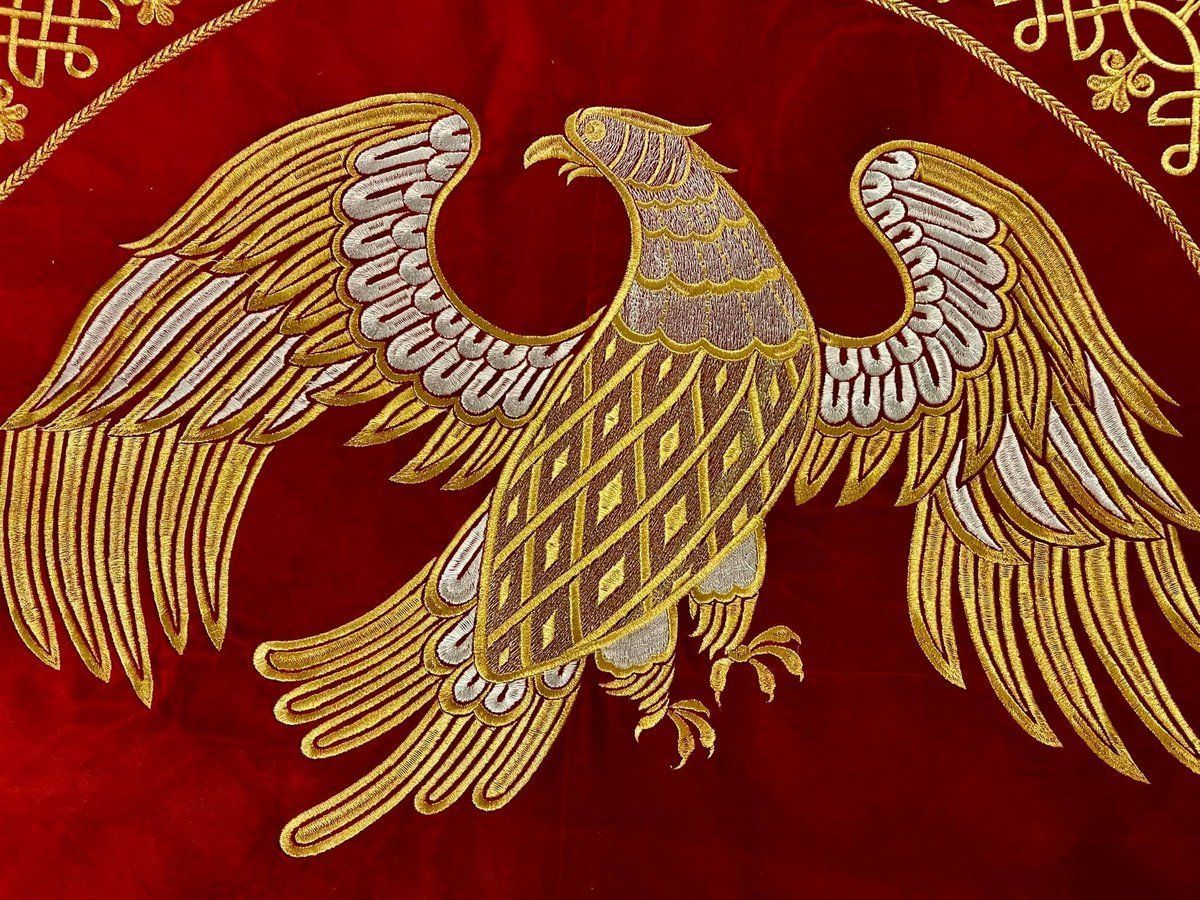
The orletsy are small embroidered rugs, roughly half a metre square, with an icon of an eagle in flight over a walled city woven or embroidered at the centre. Subdeacons place them on the floor at specific points where the bishop stands during the Liturgy — at the cathedra, before the Royal Doors, at the throne, before the Holy Table.
The eagle is a Byzantine imperial symbol — the double-headed eagle of the empire — but in Orthodox use the eagle represents the bishop himself: the herald of the Word who soars above the city he governs, watching over his diocese as the eagle over its territory. Orletsy are universal in Russian practice and increasingly common in Greek and Antiochian parishes that host their bishops for hierarchical services.
Putting It All Together: A Hierarchical Liturgy
The full sequence of a hierarchical Liturgy is a slow choreography of vestments. The bishop enters the church in the mantya, accompanied by his subdeacons, processing to the centre of the nave. He is met by the local clergy. He kisses the Gospel and the cross, blesses the people with the dikirion (two-candle) and trikirion (three-candle), and stands at the cathedra in the centre of the church.
Then the vesting begins, in front of the people, on the orletsy: the mantya is removed, the sticharion is put on, the epitrachelion, the zone, the cuffs, the epigonation, the sakkos, and finally the great omophorion. The mitre is placed on his head and the panagia and engolpion suspended. The whole vesting takes about ten minutes and is accompanied by prayers chanted by the deacon.
When the bishop is fully vested, the icon of Christ as High Priest stands at the centre of the nave. The Liturgy begins.
Commissioning Bishop's Vestments
A bishop's set is a substantial commission — far beyond a parish's normal budget — and is usually undertaken either when a new bishop is consecrated or when an existing bishop's vestments have worn out beyond restoration. A complete set, with hand-embroidered sakkos and omophorion, mitre, and the full complement of small pieces, runs from $8,000 for a simpler set to $25,000 or more for a fully goldworked archiepiscopal commission.
If you are part of a diocese commissioning a set for a new bishop, contact us through our contact page — these are bespoke projects with custom iconography and lead times of 4–8 months. We design each piece in consultation with the bishop himself and his cathedra staff, so that the iconography reflects his patronal saints and the saints of his diocese.