Watching an Orthodox priest serve the Divine Liturgy for the first time, most newcomers notice the same thing: the layered, embroidered, gold-touched garments that fill the front of the church. They aren't costume. Each piece has a name, a prayer that is said while vesting in it, a liturgical colour, and a place in tradition reaching back to the early centuries of the Church.
This article walks through every garment an Orthodox priest wears at the altar — what it's called, what it means, and what shape it takes today. By the end you'll be able to look at a vested priest and read his clothing as the Church reads it: as a moving liturgical text.
The Five Pieces of a Priest's Liturgical Vestments
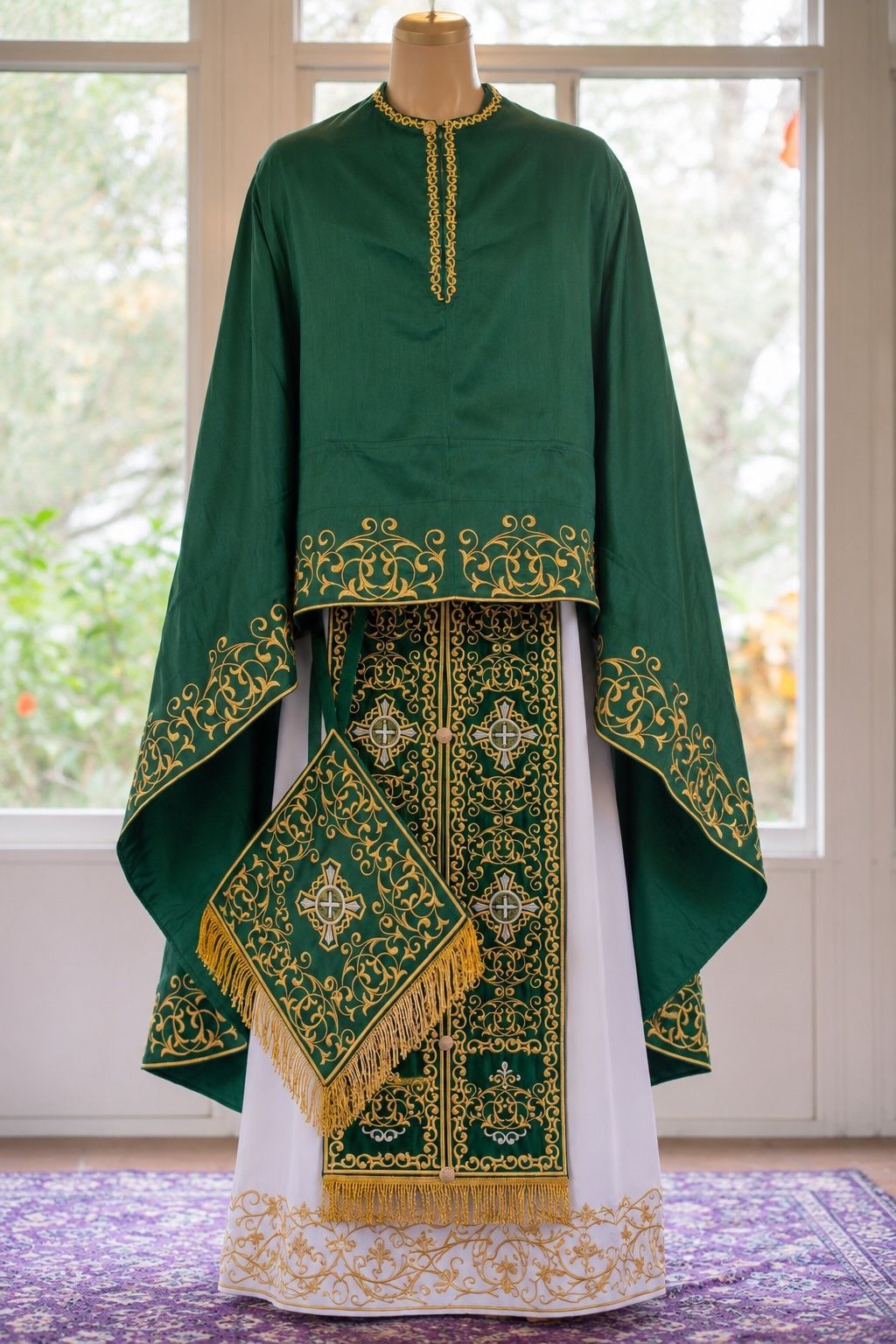
A priest's basic vestments — what he must put on to celebrate the Divine Liturgy — are five:
- Sticharion — the long inner robe.
- Epitrachelion — the stole worn around the neck.
- Zone — the belt.
- Poruchi (also called epimanikia) — the cuffs.
- Phelonion — the outer chasuble.
Plus, when granted by his bishop as an honour, the nabedrennik and the epigonation. We'll cover those too.
Each garment is put on in a specific order, with a specific verse from the Psalms or the prophets said while vesting. The whole ritual takes about three minutes and is one of the quietest, most concentrated parts of the priest's preparation. To browse vestments by piece, see our priest vestments category.
1. The Sticharion: The Garment of Baptism
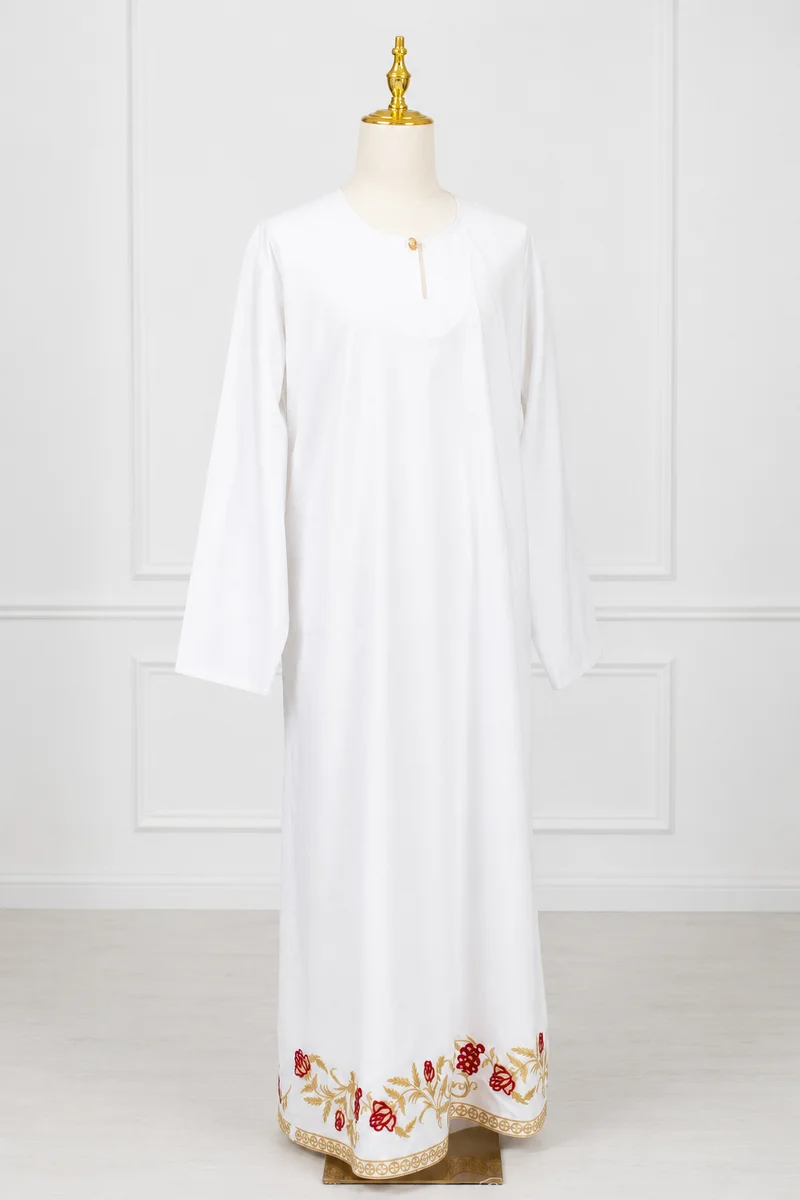
The sticharion is the priest's innermost vestment — a long, ankle-length robe with full sleeves and a deep neckline that fits over the head. It is the same garment, in shape, that every baptised Orthodox Christian symbolically receives at baptism: a white robe representing the new life in Christ.
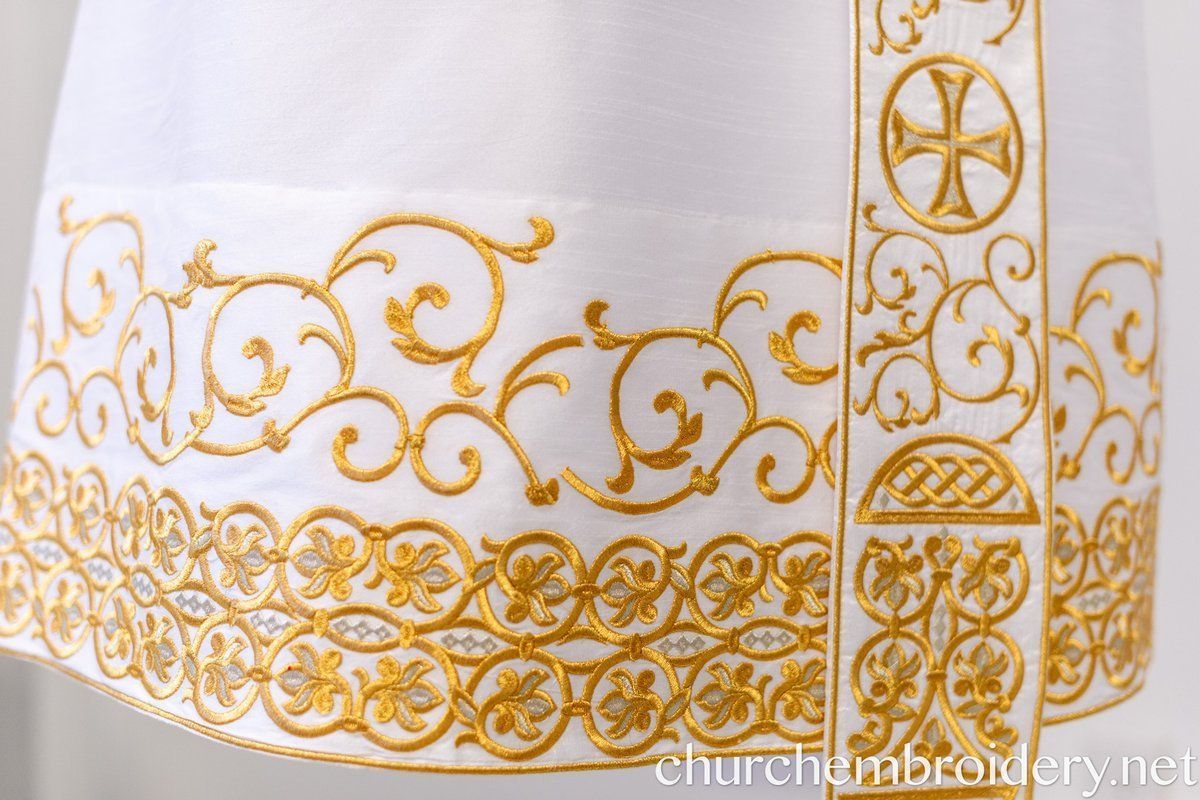
At the altar, the priest's sticharion is mostly hidden by the phelonion above it. You may glimpse the embroidered cuffs and hem when his arms move. In Greek-cut vestments it is usually plain; in Slavic-cut vestments it can be more visibly trimmed.
The vesting prayer is from Isaiah: "My soul shall rejoice in the Lord, for He has clothed me with the garment of salvation and covered me with the robe of gladness." It is the same verse used when a new baptised Christian receives his white baptismal robe — a deliberate echo. The priest is being vested not as someone special, but as one of the baptised, raised to a particular ministry.
2. The Epitrachelion: The Yoke of Priesthood
Over the sticharion goes the epitrachelion — Greek for "around the neck." It is the priest's stole: a long band of embroidered cloth doubled around the neck, fastened in front, and falling almost to the hem of the sticharion. It is the single most theologically charged vestment a priest puts on.
A priest cannot serve any of the Mysteries — Baptism, Confession, Marriage, Anointing — without the epitrachelion. Even at the bedside of the dying, before the priest hears confession or administers Holy Communion, he puts on his epitrachelion. If you ever see a priest hearing confession in a side chapel and wonder why he is wearing a long stole over his cassock with no other vestments — that is the epitrachelion. It is what the grace of priesthood is bound to.
The vesting prayer is, again, from the Psalms: "Blessed is God, who pours out His grace upon His priests as ointment on the head, that runs down upon the beard, the beard of Aaron." The image is of ordination itself.
3. The Zone: The Belt of Strength
Once the epitrachelion is in place, the priest puts on the zone — a fabric belt worn over the sticharion and the epitrachelion together, drawing them in at the waist. It is the most practical of the vestments: it keeps the sticharion from billowing and lets the priest move freely.
The vesting prayer points to its symbolic meaning: "Blessed is God, who girds me with strength, and makes my way blameless." The belt is a sign that the priest is girded for service, like the workers in the Gospel parables who tied up their long robes before going to labour in the field.
4. The Poruchi: The Bonds of Christ
Around each wrist the priest binds a poruchi (Slavonic) or epimanikion (Greek) — an embroidered cuff, roughly half a hand wide, tied on with thin cords along the inside of the wrist.
The cuffs are the only vestments that actually tie on rather than slip over the head. They have two layers of meaning. The first, recalled in the vesting prayer, is the strength of God's right hand: "Thy right hand, O Lord, is glorified in strength." The second is more sombre: they recall the cords that bound the hands of Christ when He was led to His Passion. To bind the priest's wrists at the start of every Liturgy is to remember whose hands he is borrowing.
5. The Phelonion: The Outer Chasuble
The last piece — and the most visible — is the phelonion, the outer chasuble. It is a large, somewhat circular piece of brocade with an opening in the centre for the head, falling longer at the back than the front so the priest's hands are free to bless and to handle the Holy Gifts. Most of what people picture when they think of an Orthodox priest at the altar is the phelonion: the gold or red or blue garment with embroidered crosses and trim that catches the light from the candles.
The phelonion has two main forms:
- Greek-cut: fuller and more rounded, falling to mid-calf, with a wide neckline. The classic Byzantine shape.
- Russian-cut: narrower, with a tall, stiffened back like a high collar — the silhouette familiar from Russian and Ukrainian parishes. It was developed in the late seventeenth and eighteenth centuries as Russian liturgical art developed its own style.
The colour of the phelonion follows the liturgical season — gold for ordinary Sundays and feasts of the Lord, white for Pascha and Theophany, red for martyrs, blue for the Theotokos, green for Pentecost, purple for Great Lent, black for Lenten weekdays and funerals. For a full guide, see our article on liturgical colours and when they're used.
The Honorary Vestments: Nabedrennik and Epigonation
Beyond the basic five, a priest may be granted by his bishop one or both of two further vestments. These are awards, given after years of service:
- Nabedrennik: a rectangular embroidered cloth worn hanging from a strap over the right hip. It is the first hierarchical award a priest typically receives, usually after several years of service. The icon embroidered on it is often the Resurrection or a cross.
- Epigonation: a stiff, diamond-shaped embroidered cloth hung from the belt on the right side. It is a higher award, granted to senior priests and standard for bishops. The shape recalls the sword of the spirit — the priest as defender of the faith.
Most parish priests wear neither during their first years. A protopresbyter or archimandrite will wear both, plus a pectoral cross.
Underneath: Cassock and Inner Vestments
Beneath the liturgical vestments the priest wears his cassock (Russian: podriasnik under and ryassa over; Greek: rason) — the daily clothing of Orthodox clergy outside the altar. The cassock is not a liturgical vestment in the same sense as the phelonion or sticharion: a priest wears it whenever he is officially "the priest," whether at the altar, hearing confession, visiting the sick, or just going about parish business.
The cassock is also worn under all liturgical vestments — so the full layering is, from inside out: cassock, sticharion, epitrachelion + zone, poruchi at the wrists, phelonion on top, and (if granted) nabedrennik or epigonation hanging from the belt at the right hip.
Why So Many Layers?
The vestments aren't decoration. Each one came into the tradition for a reason — most of them inherited from late Roman court dress or the daily clothing of the early Christian centuries, then preserved as the rest of the world's clothing changed. The sticharion is the Roman tunic of the second and third centuries. The phelonion is the Roman paenula, a travelling cloak. The orarion (worn by deacons) is the linen napkin servants wore over their shoulder. None of these were invented for the Church; they were what people wore in the late Roman world, and the Church kept them when the world moved on.
The result is a vested priest at the altar wearing, in essence, the everyday clothing of a fourth-century Christian — woven now from heavy brocade, embroidered now with gold thread, but recognisable to anyone who saw John Chrysostom celebrate the Liturgy in Antioch.
What a Set of Vestments Costs
A complete priest vestment set — phelonion, sticharion, epitrachelion, zone, and poruchi — runs from about $700 for a simple gold set to $3,000 or more for hand-embroidered goldwork with icon panels on the back. Most parishes order their first set for ordination and add seasonal colours over the years.
If you're considering a commission — for an ordination, a parish gift, or simply replacing a worn set after years of service — see our priest vestments category for current designs, or read our guide on what to order for a new priest's ordination.
One Last Thing: Why It Matters
It is easy to look at all of this and conclude that liturgical vestments are an ornate inheritance from a more theatrical age. They are not. They are catechesis in cloth — a way the Church teaches her theology through the senses, slowly, repeatedly, week after week. The cuffs remind a priest, every Sunday morning, whose Passion he is entering. The white sticharion reminds him, every Sunday morning, of his baptism. The phelonion reminds him that the glory of his service comes from above and not from himself.
None of these things are said aloud during the Liturgy. They are just worn. And after a few decades of being worn, they teach.