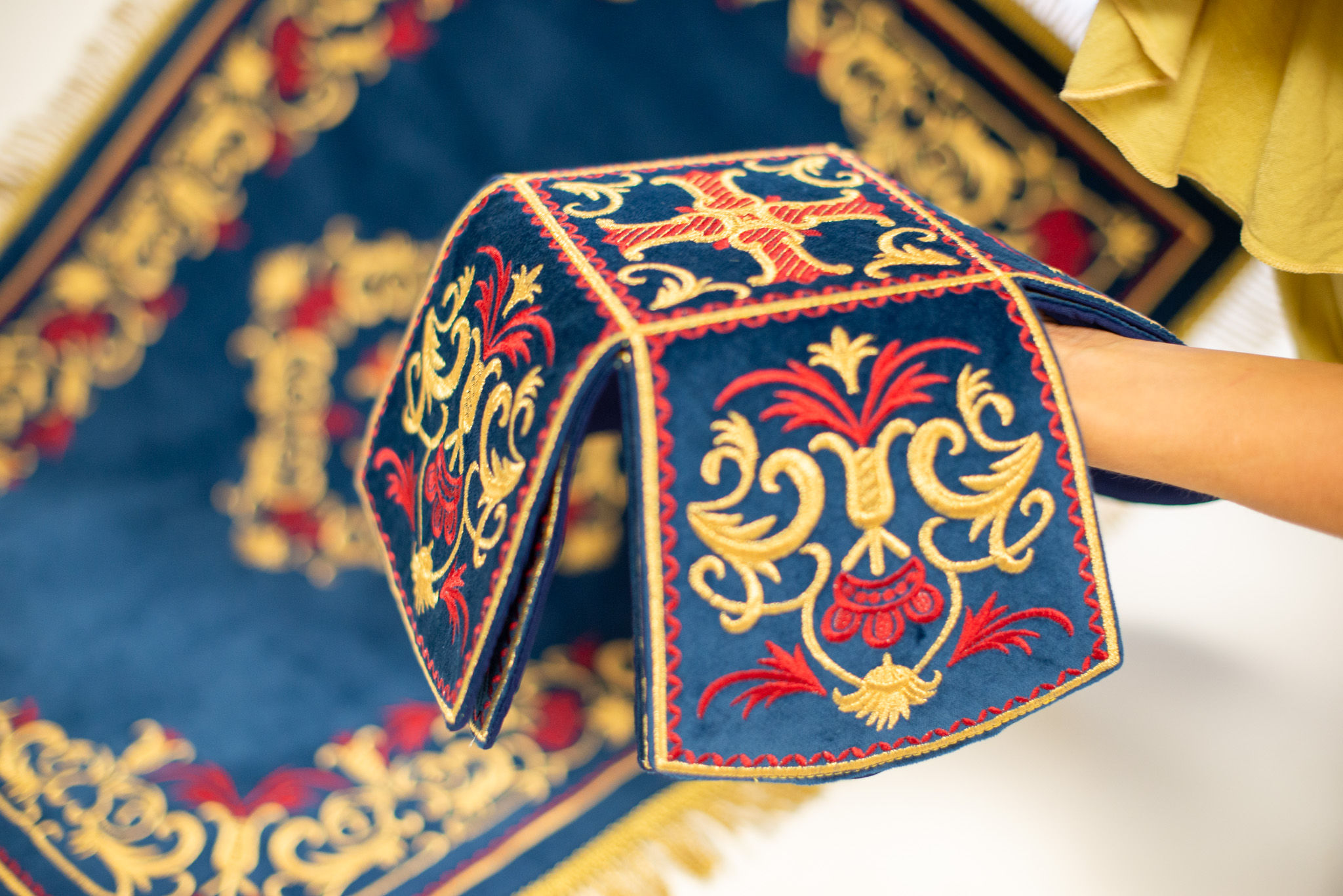
Look closely at the centre of any Orthodox altar during the Divine Liturgy and you will see, at the moment of preparation, three pieces of embroidered cloth: a large one draped over the whole arrangement of the chalice and the diskos, and two smaller ones covering each separately beneath. These are the chalice covers — in liturgical tradition, the aer and the two veils — and together they form one of the most theologically rich sets of textile in the entire Orthodox liturgical wardrobe.
Most lay people don't notice them. They are removed at specific moments and laid aside; the iconography on them is small and the action quick. But they carry the symbolism of the burial and resurrection of Christ as immediately as anything in the Liturgy, and they are made and embroidered with the same care as the priest's outer vestments.
This article walks through all three pieces, what each is for, when it is used during the Liturgy, what iconography traditionally appears on each, and how to commission a coordinated set for your parish.
The Three-Piece Set
A traditional Orthodox chalice cover set consists of three matching pieces, sewn from the same brocade and embroidered to coordinate:
- The aer — the largest of the three, draped over both the chalice and the diskos at the Proskomedia. Square or rectangular, typically 60×60 cm (24×24 inches), with the most elaborate embroidery of the three.
- The diskos veil — the smaller cover for the diskos (paten), where the Lamb is prepared. Roughly 35×35 cm (14×14 inches).
- The chalice veil — the cover for the chalice itself, sized to drape over a standard chalice with comfortable overhang.
The three pieces are always made and ordered together, so the brocade, the embroidery style, and the iconography read as one set. To browse current sets, see our chalice covers category.
The Aer: The Stone Rolled Away from the Tomb
The aer (from the Greek for "air," because it is briefly held aloft in the air during the Liturgy) is the largest and most iconographically rich of the three. In its central panel one of three subjects is almost always embroidered:
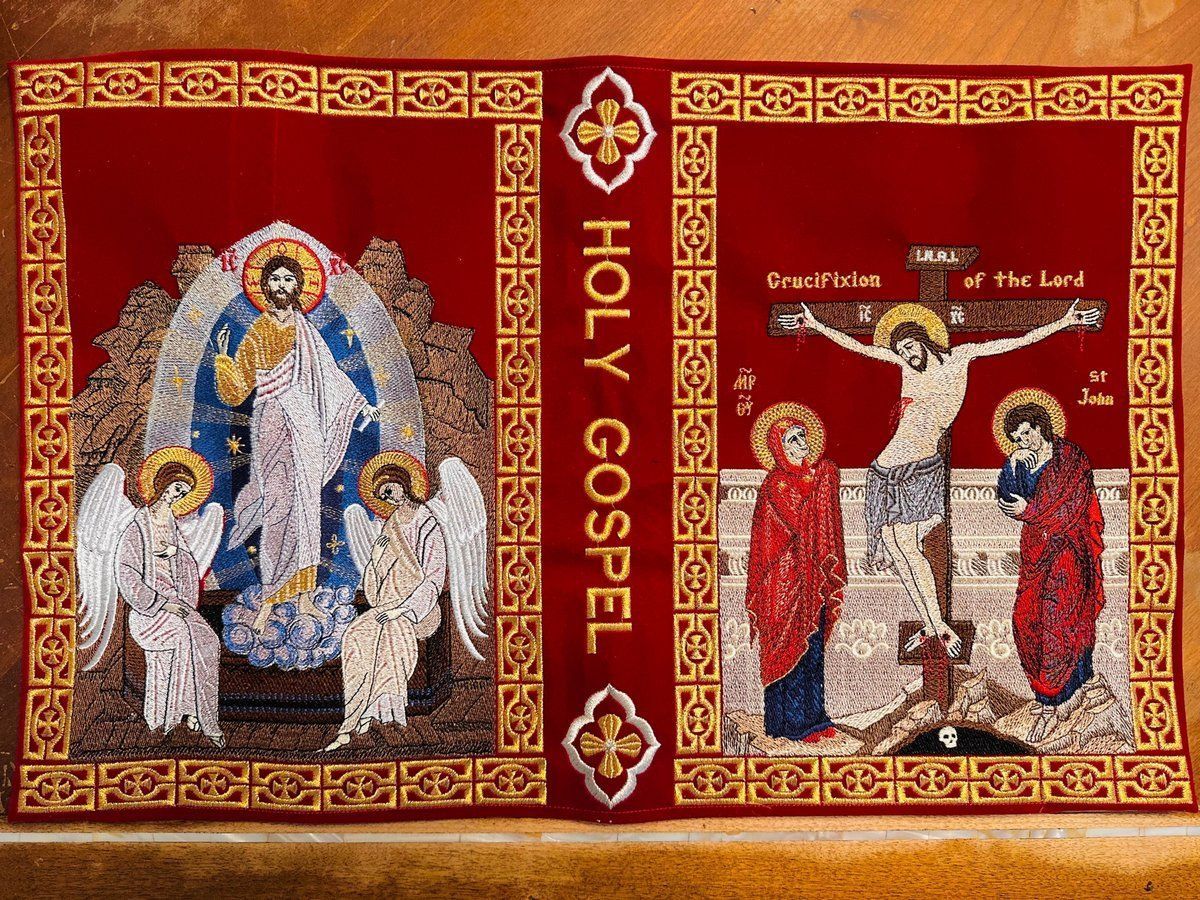
- The Burial of Christ — the Lord lying in the tomb, surrounded by the myrrh-bearing women, His Mother, John the Theologian, Joseph of Arimathea, and angels. This is the most theologically pointed choice: the aer literally covers what represents Christ's body and blood, just as the burial shroud covered His body in the tomb.
- The Lamb of God — an icon of Christ as the sacrificial Lamb, sometimes with attending angels. The reference is to Christ as the Lamb who takes away the sins of the world, slain "from the foundation of the world."
- A large cross with the Crucifixion — sometimes with the instruments of the Passion arranged around it.
The aer is removed from the chalice and the diskos at a specific moment of the Divine Liturgy — during the Symbol of Faith (the Nicene Creed) — and held over the Gifts by the deacon (or by the priest himself in some traditions) and waved gently throughout the singing of the Creed and the Anaphora. The wave represents the descent of the Holy Spirit upon the Gifts and the breath of the Spirit moving over the tomb at the resurrection.
Iconographically and theologically, the aer is the stone rolled away from the tomb of Christ at the resurrection. The lifting and waving of the aer at the heart of the Liturgy is one of the most moving choreographies in the entire service.
The Diskos Veil
The diskos veil covers the diskos (paten) — the metal disc on which the prepared Lamb (the eucharistic bread, cut from the loaf during the Proskomedia) rests through the Liturgy. The diskos veil is smaller than the aer, roughly square, and typically embroidered with one of:
- A star — recalling the Star of Bethlehem that led the Magi to the infant Christ. The star is appropriate because the diskos holds the Lamb (Christ Himself) as the manger held Him at the Nativity.
- The Nativity — a fuller scene of the infant Christ in the manger, with the Mother of God, Joseph, and the animals.
- A cross — simpler, used when the embroidery is to be matched to a more minimal aer.
Above the diskos at the Proskomedia, the priest places an actual metal asteriskos (a four-armed star-shaped piece of metalwork) — physically representing the same Star of Bethlehem. The diskos veil rests over both the diskos and the asteriskos. When the veil is removed, the asteriskos stays in place. Many parishes order the diskos veil with a star embroidered on it precisely to mirror this asteriskos below.
The Chalice Veil
The chalice veil covers the chalice — the cup that holds the wine for consecration. It is approximately square and traditionally embroidered with one of:
- The Crucifixion — Christ on the Cross, often with the Mother of God and John the Theologian standing at the foot. The image is appropriate because the chalice holds the wine that becomes the Blood of Christ shed at the Crucifixion.
- The Crown of Thorns — sometimes with the instruments of the Passion.
- A simple cross — when matched to a more elaborate aer with a single dominant icon.
The chalice veil drapes over the chalice with about 10–15 cm (4–6 inches) of overhang on each side, so it does not slip when the chalice is moved. Lined with soft cotton so it doesn't catch on the chalice rim.
How the Set Is Used in the Liturgy
The three covers come into play at four moments of the Divine Liturgy:
- At the Proskomedia (preparation of the Gifts), before the Liturgy of the Catechumens begins, the priest places the diskos veil over the diskos and the chalice veil over the chalice, then drapes the aer over both. The Gifts are now covered.
- During the Great Entrance, the deacon carries the diskos in procession, the priest follows with the chalice. The veils stay in place; the aer is removed (sometimes carried as a kind of banner over the Gifts during the procession).
- At the Symbol of Faith, the two small veils are removed from the chalice and the diskos. The aer is held over both Gifts by the deacon, who waves it gently throughout the Creed and the Anaphora.
- After the consecration, the aer is folded and placed beside the Gifts. The veils are not put back.
The whole set is then folded and stored in the sacristy after the Liturgy, ready for the next service.
Materials, Sizing, and Construction
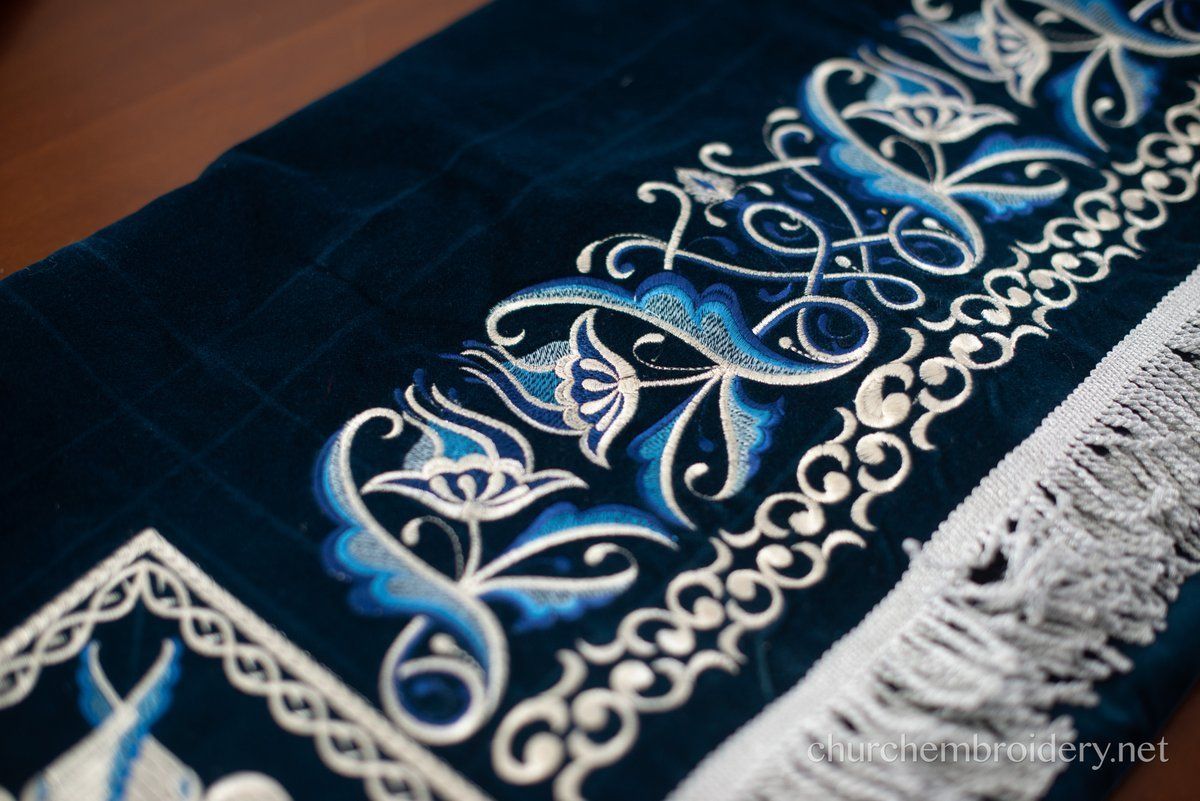
Our chalice cover sets are made from the same heavy brocade as our priest vestments and altar covers — woven in Greece or Italy, around 300–400 g/m², in the colour of the liturgical season. The lining is soft cotton or silk to protect the chalice rim and ensure the aer drapes correctly. Embroidery is mounted as a separate panel and stitched onto the brocade, so the central iconographic panel can be re-mounted onto a fresh brocade if the fabric ever wears out — a restoration we do regularly for parishes with antique aer panels they want to keep using.
Standard sizes work for most North American and European chalices and patens. For non-standard altarware (especially custom-made goldsmith chalices from Greece or Mount Athos), please send us the height of your chalice from base to rim, the diameter of the cup at the rim, and the diameter of your paten when you order — we'll size the set to fit.
Coordinating with Altar Covers and Vestments
Many parishes order their first chalice cover set as part of a larger commission together with vestments and altar covers in the same brocade. This is the most cost-effective and most aesthetically unified approach. Ordering separately almost always produces small but visible mismatches in the gold of the brocade or the shade of the embroidery — the human eye catches these even when no one in the parish can articulate what's wrong.
A coordinated commission might include:
- Priest's vestment set (phelonion, sticharion, epitrachelion, zone, cuffs)
- Matching deacon's set
- Matching altar cover sized to the Holy Table
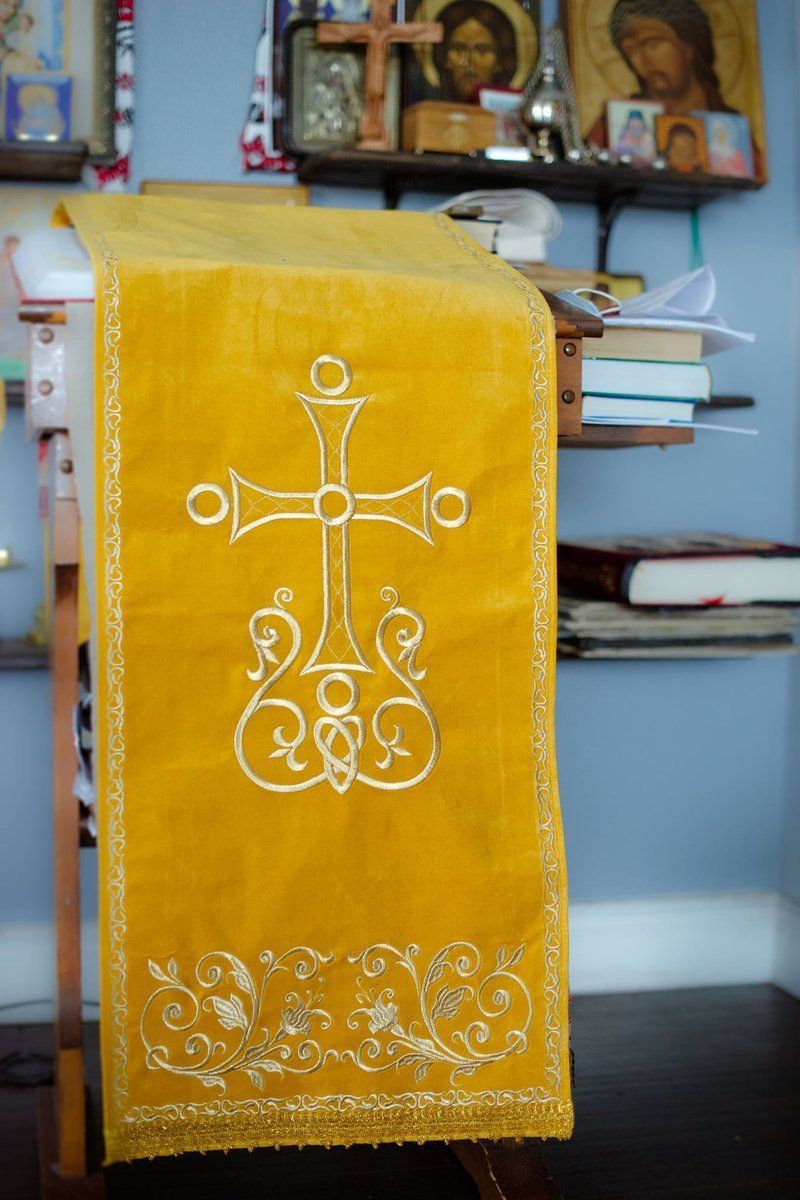
- Matching analogion (lectern) cover
- Chalice cover set (aer, diskos veil, chalice veil)
Ordered together, the brocade comes from a single bolt and the embroidery from a single design language. See our parish buying guide for budgeting and lead times.
The Aer as a Catechetical Object
One last note. The aer is the only piece of liturgical embroidery the congregation regularly sees up close at a specific moment of the Liturgy — when it is lifted and waved over the Gifts at the Creed. For that minute or two, the central icon embroidered on it is visible to anyone in the nave. Parishes choosing what to embroider on their aer would do well to remember that they are choosing what their congregation will look at during the consecration — an iconographic catechism of perhaps thirty seconds, repeated every Liturgy for the next twenty years.
For browsing or commissioning, see our chalice covers category, or contact us for a custom set coordinated with existing vestments.