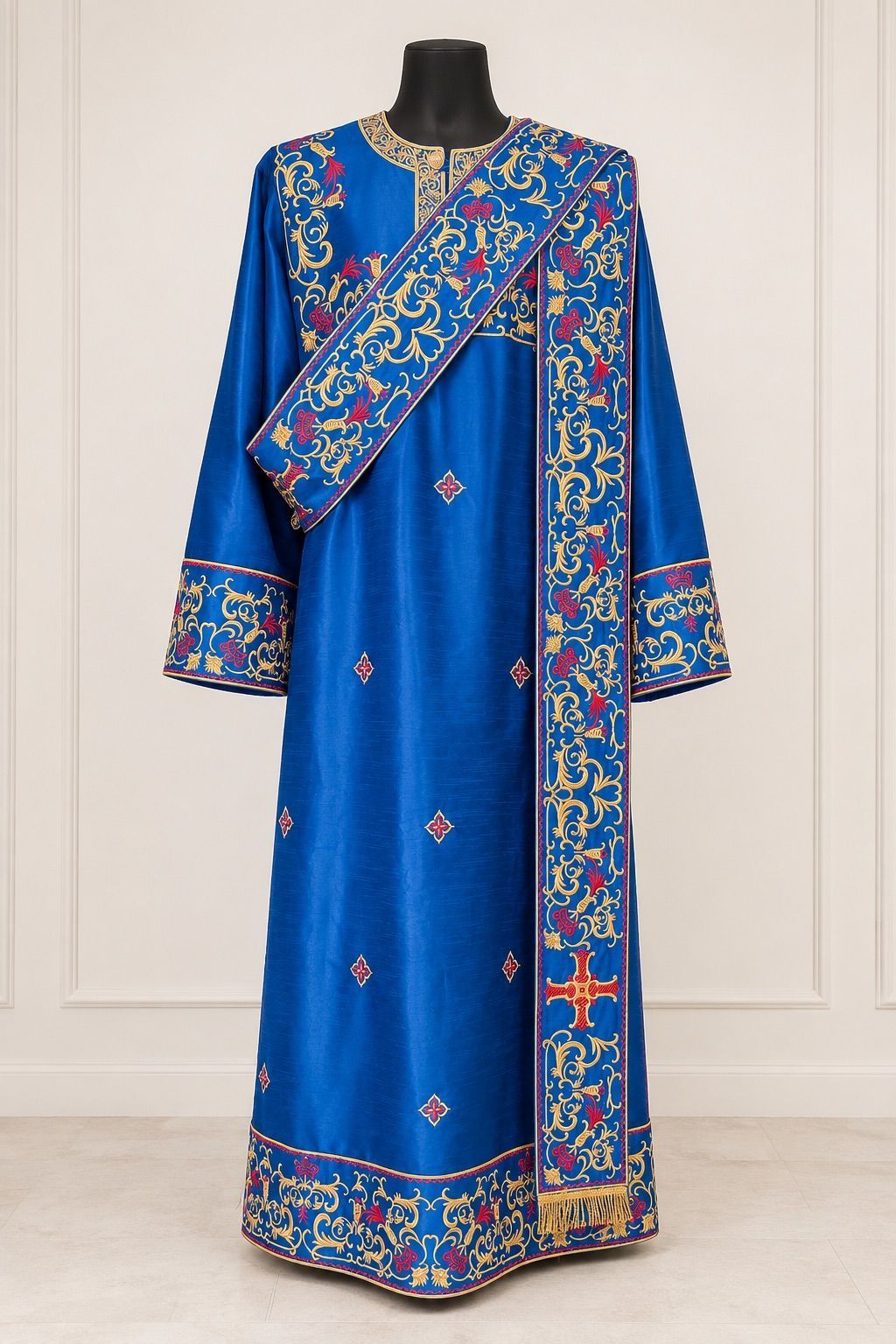
Of all Orthodox clergy, the deacon serves in the most visible way. Where the priest spends most of the Liturgy facing the altar with his back to the congregation, the deacon stands at the centre — at the doors of the iconostasis, raising the orarion at each litany, processing with the Gospel and the holy gifts, intoning the petitions, leading the dialogue between the altar and the people. Everything he does, the congregation watches.
Because of that, his vestments — the sticharion, the orarion, and the cuffs — are richer, more visibly embroidered, and more carefully designed than the corresponding pieces a priest wears under his phelonion. This guide walks through every piece, what it means, how it's worn, and what to know when commissioning a set.
The Three Pieces of a Deacon's Vestments
A deacon's basic vestments are three:
- Sticharion — the long ankle-length outer robe with wide sleeves. For a deacon, this is the principal visible vestment (unlike a priest's sticharion, which is mostly hidden under the phelonion).
- Orarion — the long narrow stole worn over the left shoulder. The most distinctive sign of the diaconate.
- Poruchi (cuffs) — embroidered bands bound around the wrists, identical in form to those worn by priests and bishops.
Together these three pieces are what a deacon must put on before he can serve at the altar. There is no Liturgy at which a deacon can serve without all three. To browse current sets in any colour, see our deacon vestments category.
The Orarion: The Distinctive Diaconal Vestment
If you remember nothing else about deacon vestments, remember the orarion. It is the single piece that, more than anything else, identifies a man as a deacon.
The orarion is a long narrow band of cloth, embroidered, worn over the left shoulder. The word comes from Latin orare — "to pray" — and the orarion is the deacon's instrument of leading prayer. During every litany of the Liturgy he raises the front end of the orarion with his right hand, signalling each petition: "Let us pray to the Lord," "Help us, save us, have mercy on us…" The lifted orarion is a visual cue to the congregation that a new petition is beginning.
The orarion's history is ancient. Canon references to it appear from the fourth century onward. Its form has been remarkably stable: a long band, embroidered with crosses at intervals, with the words "Holy, Holy, Holy, Lord of Sabaoth" inscribed in metallic thread along the front length. The form has not changed in sixteen centuries.
The traditional inscription is the Trisagion as the angels sing it in Isaiah 6: Holy, Holy, Holy, Lord of Sabaoth; heaven and earth are full of His glory. Embroidered in Slavonic (Святъ, Святъ, Святъ), Greek (Ἅγιος, Ἅγιος, Ἅγιος), Romanian, or English depending on the parish.
A standard deacon's orarion is about 4 metres (13 feet) long, finished at both ends with embroidered crosses and metallic-thread tassels.
How the Orarion Is Worn: Greek vs Slavic
The orarion is worn differently in the two main Orthodox traditions:
- Greek practice: the orarion hangs straight down from the left shoulder, both ends falling vertically — one in front and one behind. Simple and graceful.
- Slavic / Russian practice: the orarion is brought across the body — the back end is brought around under the right arm and looped up to the front, where it crosses the front end diagonally across the chest. Some priests gather the crossing end into the belt of the sticharion; others hold it in the right hand.
Both are correct and ancient. A deacon serves in whatever style his parish follows. The orarion itself is the same length and embroidery in both traditions — only the wearing differs.
The Deacon's Sticharion
A deacon's sticharion is the same essential garment as a priest's — a long ankle-length robe with wide sleeves and a slit at the neck — but it is treated very differently. Because the deacon's sticharion is his principal outer vestment (not hidden under a phelonion as the priest's is), it carries far more visible embroidery:
- A large embroidered cross on the chest and another on the back, sometimes with the inscription IC XC NI KA
- Ornamental embroidered trim down the front panel of the sticharion
- Wide embroidered bands at the cuffs and along the hem
- For premium commissions, an icon of the patronal feast or of the Mother of God on the chest panel
The cloth is the same heavy brocade we use for priest vestments, lined with cotton or polyester twill. The cut allows for the wide reach a deacon needs when censing, raising the orarion, or carrying the Gospel — a deacon's sleeve is fuller than a priest's.
The Poruchi (Cuffs)
The deacon's poruchi are the same in form as those worn by priests and bishops: roughly rectangular embroidered bands tied around the wrists with thin cords. Usually embroidered with a cross at the centre and trim around the edges, matching the embroidery of the sticharion. We make poruchi in pairs to coordinate with each set of vestments.
Symbolically, the cuffs recall the bonds that held the hands of Christ in His Passion, and the strength of the hands lifted in prayer. They are bound on as the last step of vesting, with the vesting prayer asking God to "glorify [my] right hand in strength."
The Protodeacon and Archdeacon: The Double Orarion
Senior deacons — protodeacons (the most senior deacons in a cathedral or large parish) and archdeacons (typically a deacon attached personally to a bishop) — are granted a double orarion as a sign of their rank.
The double orarion is exactly what it sounds like: a longer orarion (typically 5 metres / 16 feet) worn in a more elaborate way. The standard wear is:
- Drape over the left shoulder as for a regular orarion
- Bring the back end under the right arm, across the back
- Loop the same end back up over the left shoulder a second time
- Let the end fall down in front
The result is two visible bands of embroidered cloth crossing the body, where a regular deacon shows only one. The visual difference is immediate and unmistakable.
When you order an orarion, please specify whether it is for a regular deacon, a protodeacon, or an archdeacon. We cut the longer length and finish it with the appropriate inscription pattern.
Liturgical Colours for Deacon Vestments
Deacon vestments follow the same liturgical calendar as priest vestments — gold for most Sundays, white for Pascha, red for martyrs, blue for Theotokos feasts, green for Pentecost, purple for Lent, and so on. For a complete colour-by-colour guide see our article on liturgical colours.
Most deacons start with a gold set and add seasonal colours over years. Because deacon vestments are more visible than priest vestments, mismatched colours between deacon and priest at a concelebration are especially noticeable — so parishes try to coordinate the deacon's set with the priest's whenever possible. Ordering deacon and priest sets together in the same brocade saves money and ensures the match.
Ordination Gifts: What a Parish Commissions for a New Deacon
A deacon's ordination, like a priest's, is often celebrated with a parish gift — typically a complete vestment set in a gold or white brocade. A thoughtful ordination commission for a new deacon includes:
- Sticharion in gold brocade, with a cross or icon panel on the chest
- Orarion with the Trisagion embroidered in the language of the parish
- Matching pair of poruchi
- Optionally: the new deacon's monogram embroidered on the orarion or sticharion as a personal touch
Lead time is 4–8 weeks for a standard embroidered set, longer if the design includes icon panels or goldwork. Plan to commission 3 months ahead of the ordination at minimum. See our broader guide on ordination commissions — the same principles apply to deacons.
One Last Thing
A deacon at the doors of the iconostasis, in a richly embroidered sticharion with the orarion lifted in his right hand, is one of the most visually arresting figures in Orthodox worship. He is, in the icon-tradition, the figure of the angel — the messenger who carries the prayer between the altar and the people. His vestments are designed for that role: visible, dignified, embroidered as carefully as the icons themselves.
Browse our deacon vestments for current designs, or send us a note for a custom commission with your parish's specific tradition, colour, and embroidery preferences.