Most parishioners today have a rough mental table: white for Pascha, red for martyrs, blue for the Theotokos, violet for Lent, black for funerals. It is a tidy system — tidier, in fact, than the historical Russian Church ever was. The standardized color calendar we now take for granted is largely a twentieth-century formalization. A hundred and fifty years ago things were more nuanced, and the great Metropolitan St. Philaret of Moscow (Drozdov, 1782–1867) is one of the clearest witnesses to that earlier practice.
From 1855 to 1865 his cell deacon, Paul Sergeyevich Grozov, kept a remarkably careful diary of every vestment the metropolitan put on for every service. The combinations are sometimes surprising, often striking, and always intentional. What follows is a guided tour of how a serious, theologically literate bishop chose his liturgical colors in the middle of the nineteenth century.
1. The Governing Principle: Rank of Feast, Not Theme
Modern color charts tend to be thematic: blue means "Mother of God," red means "martyrs," gold means "saints in general." Philaret's logic was different. He matched color to the degree of liturgical solemnity, not to the iconographic subject of the day. White was for the brightest feasts; red for the next tier of celebration; green or violet for penitential days and ordinary weekdays; black appeared during fasts when more festive colors would have been out of place.
Inside this hierarchy he allowed himself a great deal of freedom. His sacristy held some forty distinct sets, and he combined them in ways that often surprised visiting clergy.
2. White for the Greatest Feasts — Including Marian Feasts
Pascha, Theophany, and the Nativity of Christ called for white vestments. So far, no surprises.
What may surprise the modern reader is that Philaret also wore white for the great feasts of the Mother of God: the Dormition, the Nativity of the Theotokos, the Annunciation, and the Entry into the Temple. The convention of blue for Marian feasts was not yet entrenched. For Philaret the Theotokos was honored by the brightness reserved for the highest celebrations, not by a color set aside specifically for her.
This matters historically. The modern preference for blue at Marian feasts is a beautiful pious development, but it is not patristic, not Byzantine, and not standard Russian-imperial practice. The earlier instinct was that the Mother of God belongs at the very top of the festal hierarchy — not in a category of her own.
3. Gold for Imperial and Solemn Occasions
In 1856 Philaret took part in the coronation of Emperor Alexander II in the Dormition Cathedral of the Moscow Kremlin. He received a set of gold-embroidered vestments as a coronation gift. From that day forward he wore the gold vestments not only on imperial commemoration days but at any service attended by a member of the imperial family. The original coronation vestments themselves he gave to the Synodal sacristy as relics of the event.
Gold, in his hands, signaled the encounter of two anointings — that of the bishop and that of the sovereign. It was the color of state and altar meeting in one rite.
4. Blue and Violet for Lent and Fasting Periods
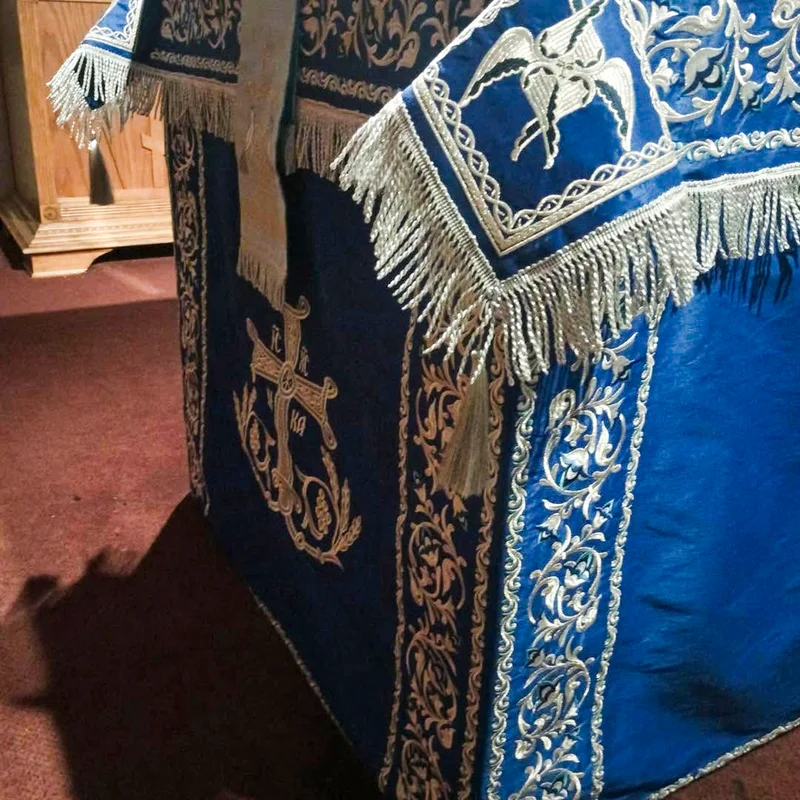
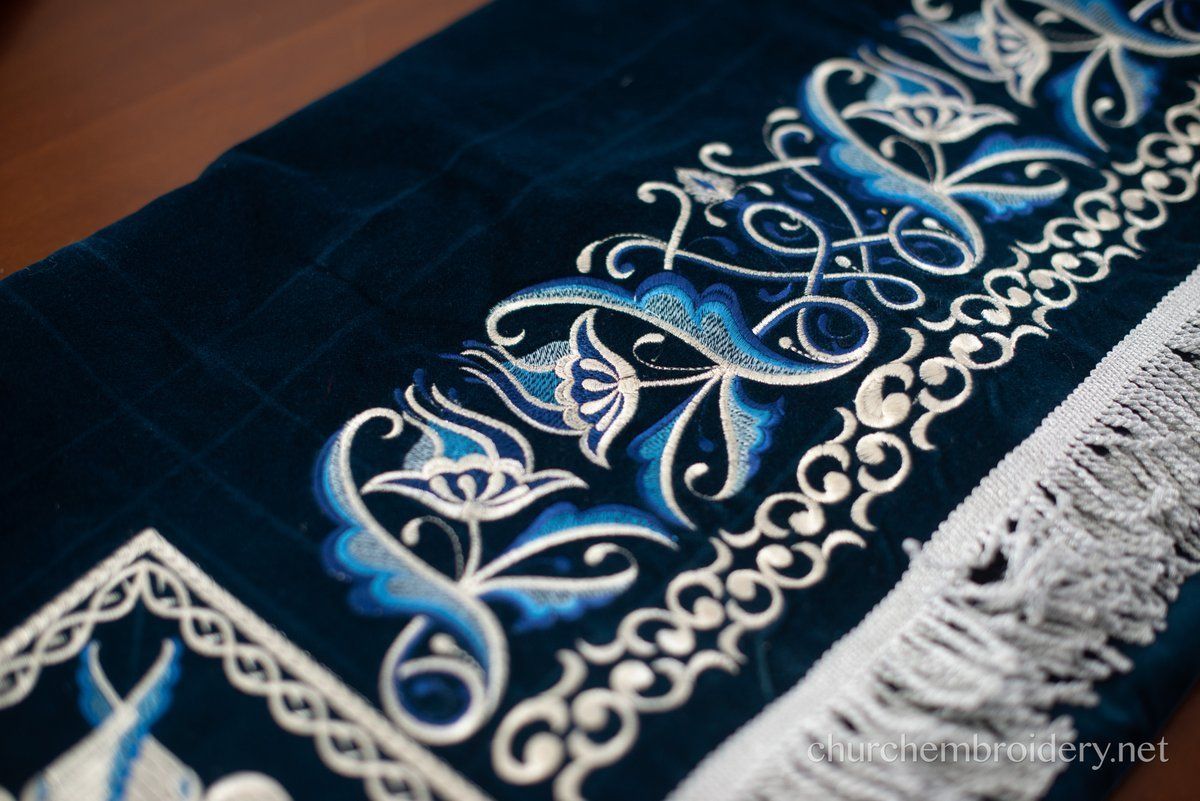
Sundays of Great Lent, weekday services within the fasts, and the vigils of the Christmas and Theophany fasts called for blue or violet. Blue was the more common choice; violet and lilac he treated as transitional shades, suitable when the day was partly festal and partly penitential.
When a major feast fell inside a fast, Philaret negotiated the conflict carefully. For example, when the Meeting of the Lord (Presentation) fell in the first weeks of Great Lent, he wore violet rather than white — the fast took precedence over the feast in matters of dress.
5. The Cross — A Calculated Ambiguity
The Exaltation of the Cross is one of the great mid-September feasts but is also a strict fast day. Philaret used both white and violet on this day, depending on the year and context, without ever settling on a fixed rule. The choice itself preached: the Cross is at once the most festal of Christian symbols and the most sorrowful of Christian instruments. He let the vestments hold that tension instead of resolving it artificially.
6. Polychromy: He Almost Never Wore One Color
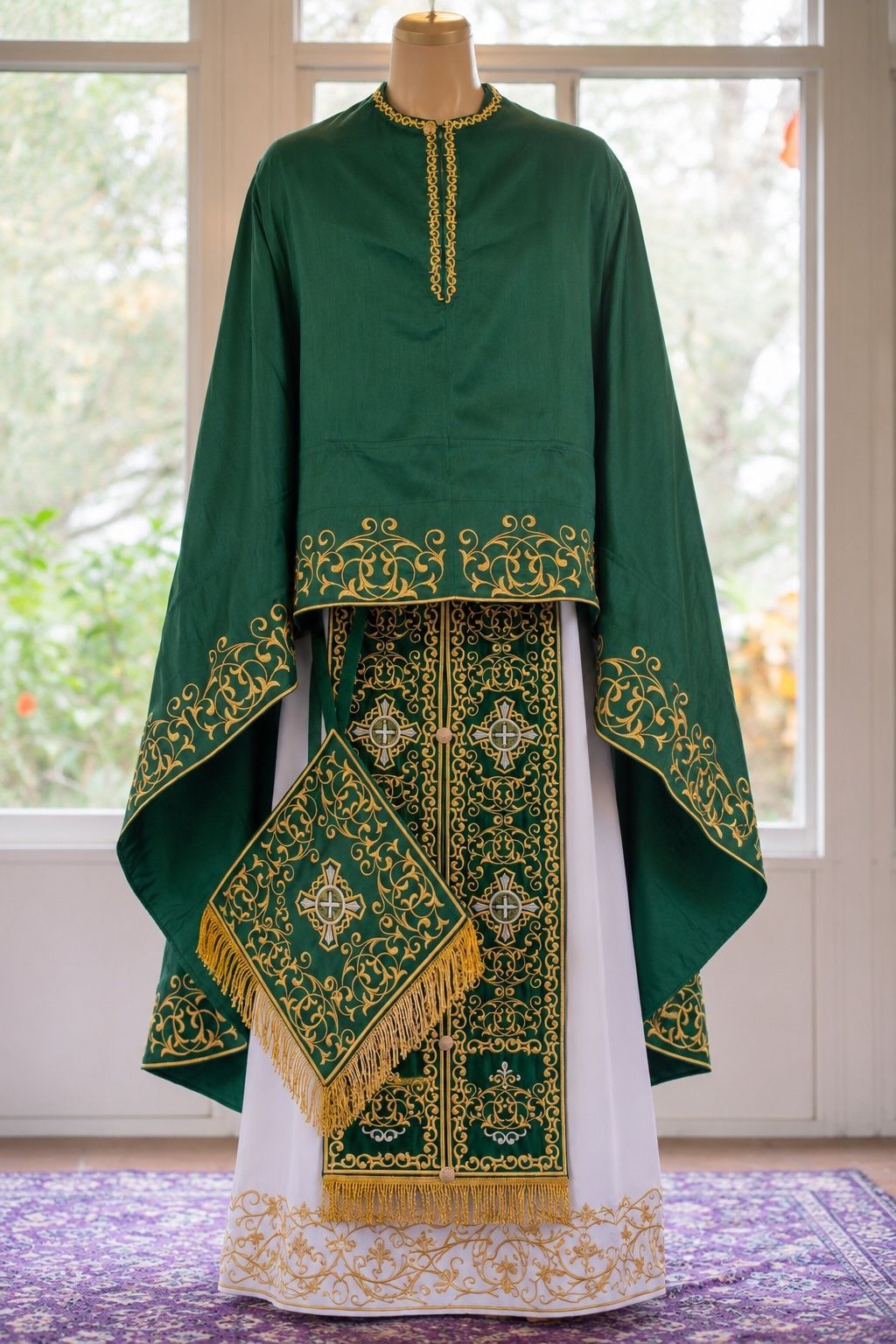
Perhaps the most distinctive feature of Philaret's practice was that he almost never appeared in a monochromatic set. He paired colors deliberately. A green sakkos might be combined with a blue sticharion, blue epitrachelion, blue cuffs, blue omophorion, and a violet mitre. Gold vestments would appear with a white omophorion and a crimson mitre. Blue cassocks could be matched with a green mitre.
Some of this reflected the practical reality of nineteenth-century vestment production — each piece was sewn and embroidered individually, so completing matching sets in five or seven colors at once was rarely possible. But the consistency of his polychromy across a decade of services shows that he embraced it as a positive principle, not merely tolerated it.
7. Coordinating the Concelebrants
When several priests served with him, Philaret often dictated their vestments too. On Christmas Eve 1861, for instance, the metropolitan wore violet while concelebrating priests wore blue, and the altar dressings were tied to the priests' color rather than the bishop's. At church consecrations he commonly changed vestments midway through — one color for the preliminary rite of consecration, a contrasting color for the Divine Liturgy proper.
A note he wrote organizing a commemoration of the 1825 events directed his clergy to wear "festive, polychrome brocade" and explicitly forbade "white or monochromatic velvet" lest the assembly become visually flat. He cared about how the gathered clergy looked as a group: harmony but not uniformity, similarity between deacons and between priests but contrast between the two ranks.
8. What This Means for Us Today
The modern Russian liturgical color calendar — gold for ordinary Sundays, red for Pascha, blue for the Theotokos, green for the Holy Spirit and venerable monastics, violet for Lent, white for funerals — is a useful catechetical tool. It teaches the year to children, sacristans, and choir directors at a glance.
But Philaret reminds us that the older instinct was more flexible. The rule of dress was not "this color means that feast." The rule was: match the solemnity, harmonize the colors among the clergy, and let the choice itself say something about what is being celebrated.
For a parish ordering new Orthodox vestments, this is liberating. A second set of white vestments — lighter and more festive than the first — is not a redundancy; it is a deliberate gift to the great feasts. A blue phelonion can be either Marian or penitential depending on the choices around it. Even a gold set need not be paired with a gold mitre to be properly used.
9. Building a Sacristy in the Tradition
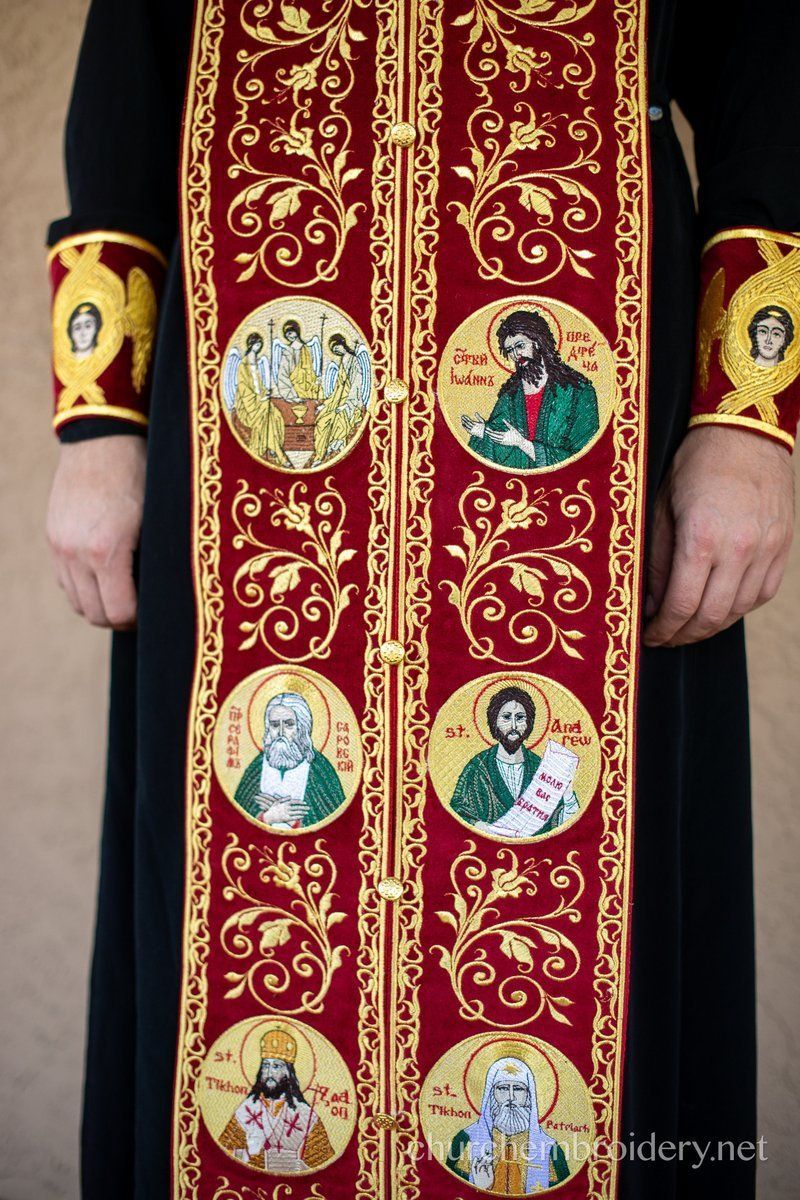
At our atelier we make vestments in the full range of liturgical colors — white, gold, red, blue, violet, green, black, and several lesser shades — with embroidery patterns adapted from Byzantine and Russian sources. We can match an existing set, build a coordinated season-by-season sacristy, or supply a single piece — an epitrachelion, a sakkos, a phelonion, a pair of cuffs — in the exact shade you need.
If you are planning a new priest vestment set, a deacon set, or building out the bishop's sacristy for a cathedral or monastery, we are happy to talk through the color combinations and the order of pieces. Send us a note and we will work it out together.
Sources: Diary of Deacon Paul Sergeyevich Grozov (1855–1865), preserved in the archives of the Moscow Synodal Sacristy; correspondence of St. Philaret of Moscow; archival study published in the proceedings of the Moscow Theological Academy. See also the parallel article on the origin of Orthodox vestments.